Story County Conservation – Prairie Rivers of Iowa Featured Partner

Story County Conservation – Prairie Rivers of Iowa Featured Partner

Connecting people with nature and improving natural resources — making Story County a great place to live, work, and recreate. — Story County Conservation’s Mission

Story County Conservation (SCC) maintains over 3,500 acres of parks and natural areas like prairies, wetlands, and oxbows. Special areas of focus include preserving native environments and habitat restoration, stopping the spread of invasive species,  and water quality improvement.

Recreationally, SCC offers a variety of outdoor leisure opportunities and quality recreational facilities that feature fishing, bird watching, camping, hiking, swimming, picnicking, boating, bicycling, and hunting.

They are instrumental in helping landowners develop and manage wildlife and habitat plantings and maintain vegetation along Story County roadways.

Their outstanding environmental education program works with school districts and daycares to provide programming and outdoor field trips that promote environmental awareness and fun. Visit their website here for all the details!
Story County Conservation

Q&A

Prairie Rivers:  Why is it important for Story County to partner with Prairie Rivers of Iowa?

Story County ConservationThe mission of Story County Conservation is to connect people with nature and improve natural resources – making Story County a great place to live, work, and recreate.  This is only possible through meaningful partnerships.  Prairie Rivers of Iowa shares many of the same values and objectives.  Public-private partnerships leverage the unique abilities of each.  The Prairie Rivers/Story County Conservation partnership specifically provides feasible and meaningful improvements to the environmental and social fabric of the community. Through the partnership with PRI, SCC can engage residents through a volunteer citizen water monitoring program. The data collected twice a month is used by PRI to analyze trends and hotspots for pollutants in the county. The volunteer water monitoring program is part of a 10-year water monitoring plan developed by PRI, SCC, the City of Ames, the City of Nevada, the City of Gilbert, the City of Huxley, Iowa State University, Leopold Center for Sustainable Agriculture, Izaak Walton League, Story County Soil and Water Conservation District and the Story County Community Foundation. Additional initiatives worked on by the SCC/PRI partnership include watershed boundary signage, creek signage, creek and river clean-ups, watershed assessments, and water quality education.


Prairie Rivers: What is the first or most important thing that comes to mind that Story County Conservation has done to inspire citizens to get out and make a difference to improve conservation efforts within the county?

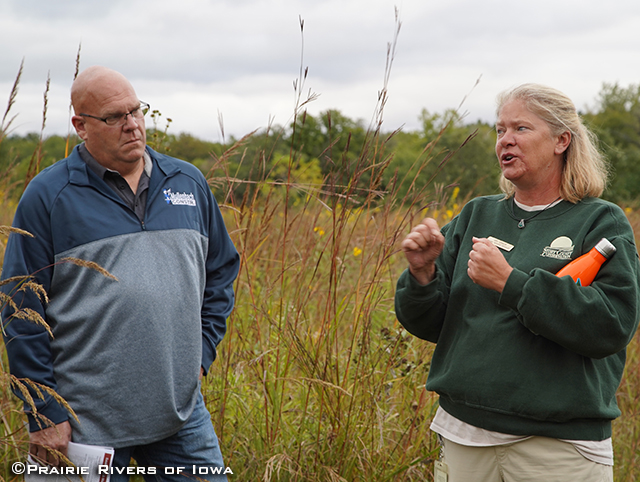
Story County Conservation:  Story County Conservation engages with people in many contexts to break down barriers to help connect people with the outdoors. Whether it be through classroom programs, discovery hikes, outdoor recreation opportunities, environmental stewardship education, and involvement, or simply opportunities to enjoy nature, SCC helps people discover the values of the natural environment.
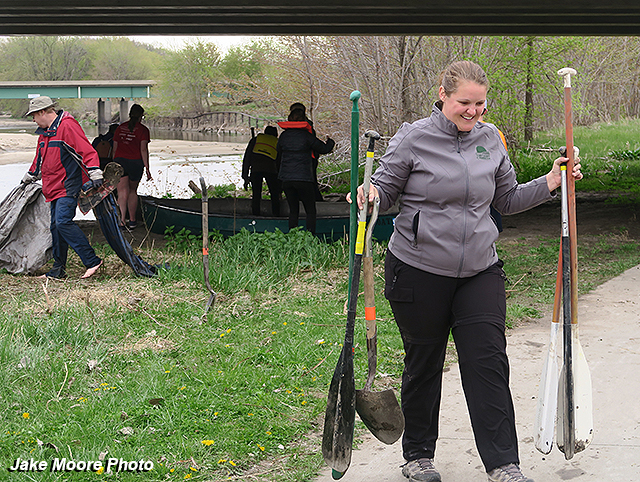
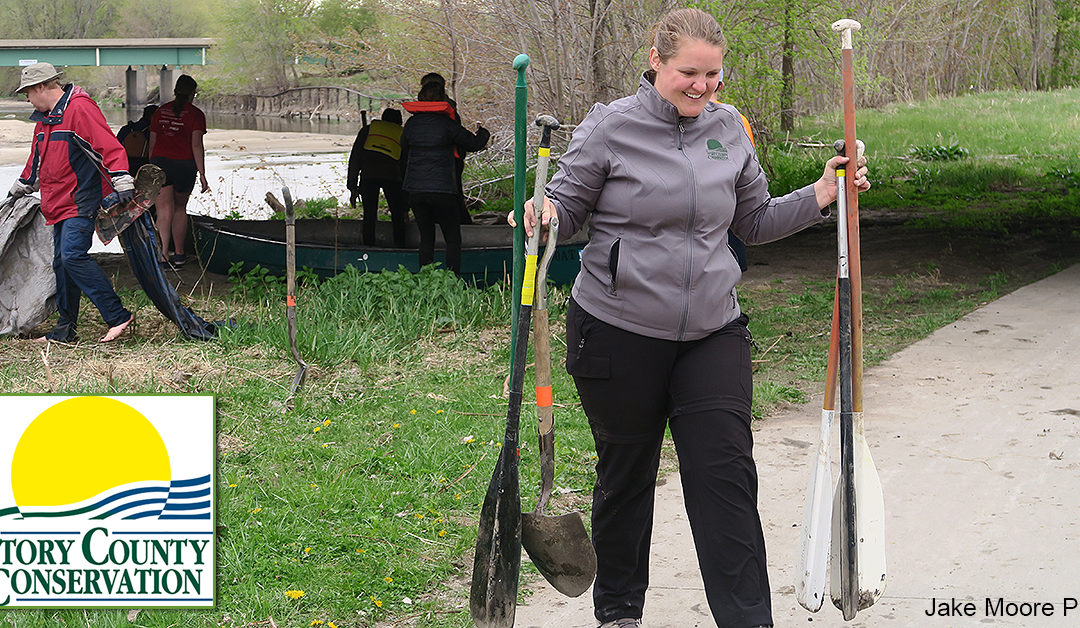
Story County Conservation Watershed Coordinator Sara Carmichael During Creek Cleanup
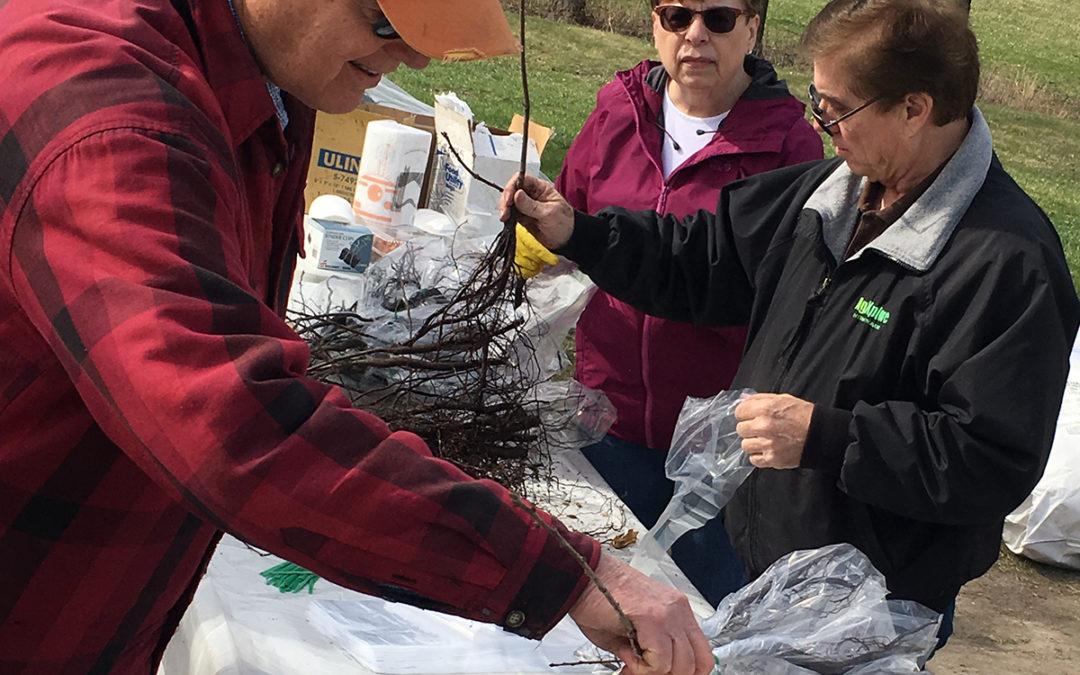
Small Landowner Workshop
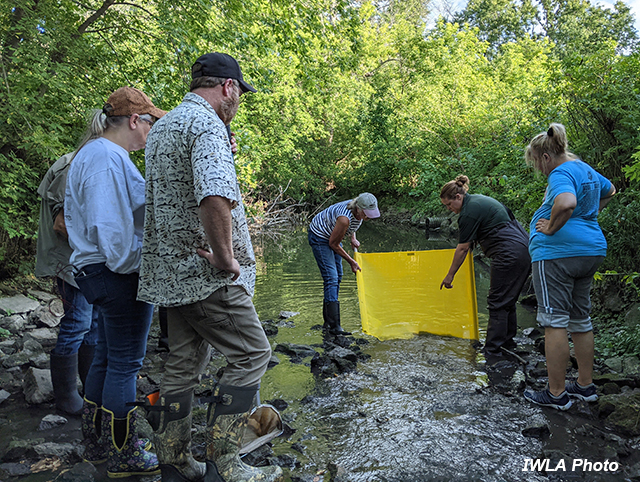
Volunteer Water Quality Monitoring
Jerry Radke Leaves a Legacy

Jerry Radke Leaves a Legacy

Jerry Radke of Nevada, Iowa was a conservationist known for his hard work and a “yes I can” attitude with a passion for improving soil and water quality. At Jerry’s request, after his passing last fall, Prairie Rivers of Iowa received many generous donations in his memory, helping us and the citizens of Story County continue his legacy and the important work involved.

His love for the outdoors and the environment started on the family farm where at a young age Jerry helped work dairy and beef cattle, hogs, chickens, ducks, and geese. Jerry would tell the story about how at the age of three his father put him on a tractor where he had to stand and brace his head against the seat so his feet could reach the pedals.

Jerry attended a one-room school through the eight-grade, went on to graduate high school, earn a bachelor of science in soils from the University of Wisconsin-Madison, a master’s in soil physics from Iowa State followed by a return to Wisconsin to earn a Ph.D. in soil physics.

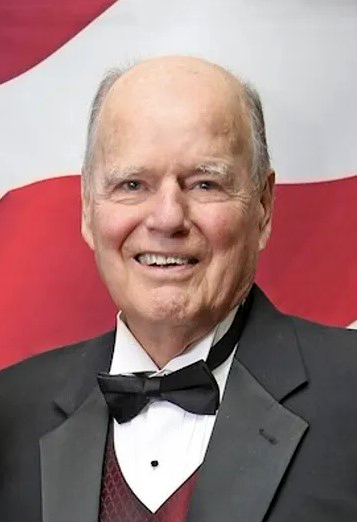
Jerry Radke
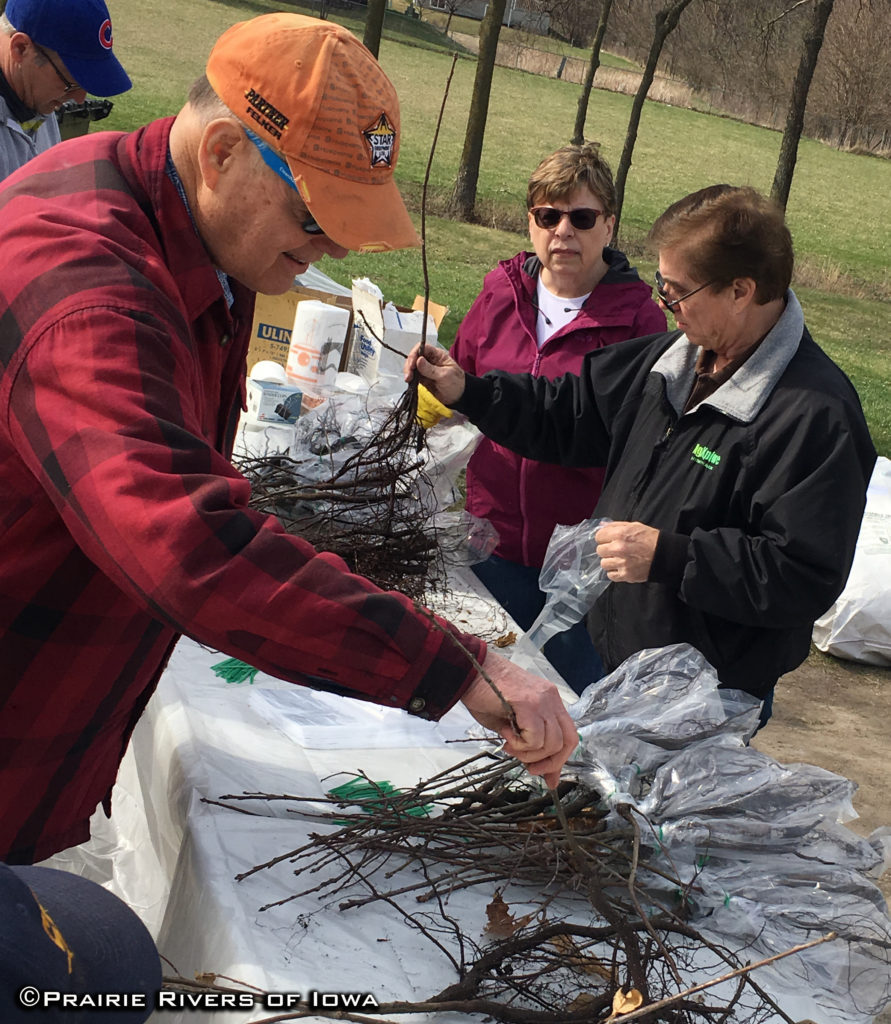
Jerry Radke volunteering during a Story County Arbor Day event.
Jerry Radke (left foreground) volunteering at a Story County Soil and Water Conservation District Arbor Day event.
During his professional career as a soil physicist, Jerry worked at the North Central Soil Conservation Research Lab in Minnesota then retired from the US Department of Agriculture, Agricultural Research at the National Soil Tilth Lab in Ames. His work took him around the world while he continued to study soil structure, soil temperature, and instrumentation. His published articles included research related to freezing and thawing soils, plus the effects of water and nutrient movement within soil profiles.

Here at Prairie Rivers, we primarily got to know Jerry through his service as a Story County Soil and Water District (SWCD) Commissioner. When asked about what was the most important legacy that Jerry left for the citizens of Story County, his daughter Katrina Radke had a hard time pointing to just one thing. He was deeply involved with the SWCD and Story County conservation projects, the Lions Club, and the church.  “He always wanted to do what was best for the soil, conservation, nature, and recycling,” Katrina shared. “He always had a compost pile and was into reusing everything as much as possible rather than wasting it.”

“Some of our most cherished family memories were hiking and camping in Minnesota state parks and national parks throughout the country,“ Katrina fondly remembers, “Obviously, his value for the environment was big. Something else I view as a legacy from him was the good old-fashioned values of discipline, hard work, pursuing what you love to do, and immersing yourself in it. He was a very honest working good man with integrity and high expectations. Being of service to humanity and the land was important to him.”
Katrina concludes with, “I loved my dad very dearly. He was very much a part of my life in terms of a creative voice and teacher.”

If you’d like to reach out to Jerry’s family with a note, please email his wife Susan at susan@susanradke.com or his daughter Katrina at coach@wecoach4u.com.

Here at Prairie Rivers of Iowa, we are grateful for the memorials given in honor of Jerry Radke and his family. If you or a loved one have questions about establishing a memorial to assist Prairie Rivers of Iowa’s work, please contact our Director Penny Brown Huber.

Iowa Lands Prominent North American Prairie Conference

Iowa Lands Prominent North American Prairie Conference

Once in a while something big and potentially impactful happens! Something that brings together people from around North America to address the issues of biodiversity, climate change, soil and water quality and more. Something that lays out information from researchers, educators, allied professionals, students, conservation specialists, landowners and organizations who will share their latest findings while raising important questions during dozens of informative sessions and exciting, hands-on field trips.

North American Prairie Conference

The North American Prairie Conference will be held on June 26 -29 in Altoona, Iowa (just outside of Des Moines), right in the heart of the tallgrass prairie region in the U.S. For four days, attendees will learn and discuss, hope and dream and craft real-world action to expand prairies on the continent. Attendees will place themselves in a world that addresses the value of one of the most important and endangered ecosystems.

Prairie Walk at Jennett Heritage Area in Story County, IA

Our future success as a society will in part derive from the degree to which we recognize and fulfill our obligation to ensure our grandchildren and their grandchildren have the opportunity to interact with and benefit from these wondrous grasslands, ” wrote Douglas Ladd in an issue of the Missouri Prairie Journal, “We depend on these bio­logical systems to sustain us as a people, meeting human needs through healthy productive soils, clean and abundant waters, pollinator reservoirs, flood and erosion prevention, and countless other amenities which taken for granted, can be prohibitively expen­sive to re-create once system integrity is lost.”

In addition, attendees can enjoy a full or half day on the land touring across Iowa to see prairie remnants! Options for field trips on June 27 include a choice amongst 17 remarkable remnant native prairies, oak-hickory savannas, research sites and expansive reconstructed prairies throughout central and southeast Iowa. Afterward, participants will revel in an evening of live entertainment, food and camaraderie with fellow participants.

Drake University Professor of Ecology and Botany Dr. Thomas Rosburg is this year’s conference chair. Rosburg will join keynote speakers including the University of Northern Iowa Tallgrass Prairie Center Director Dr. Laura Jackson, Xerces Society of Invertebrate Conservation Co-Director of Pollinator Conservation Eric Lee-Mäder and the Former Director of The Nature Conservancy in Missouri Douglas Ladd to headline the conference.

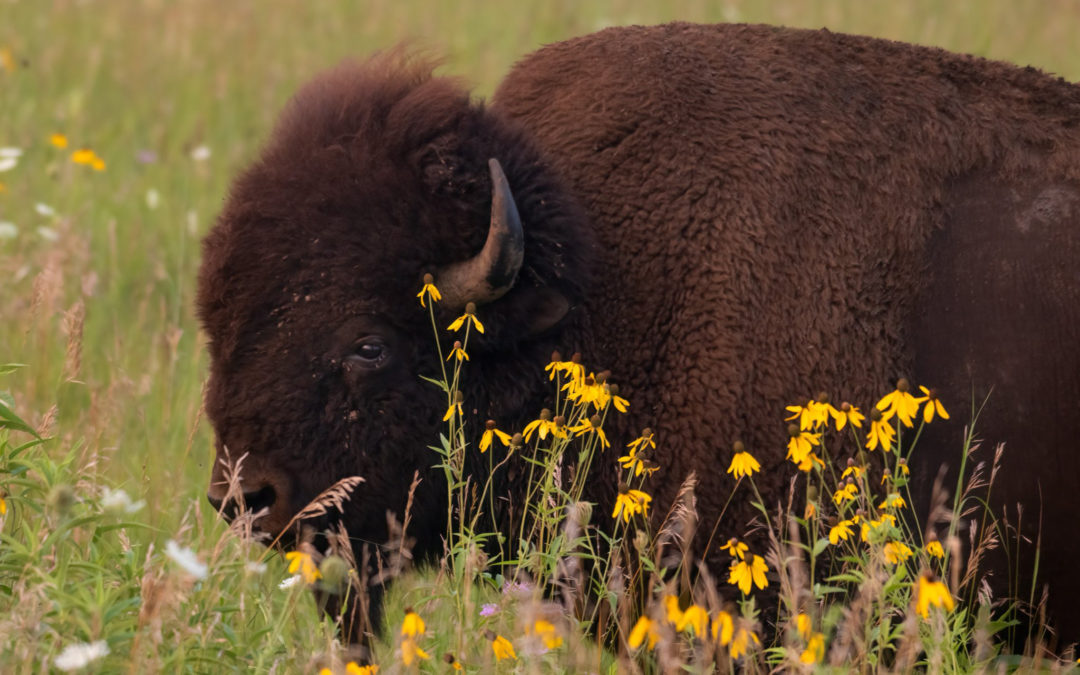
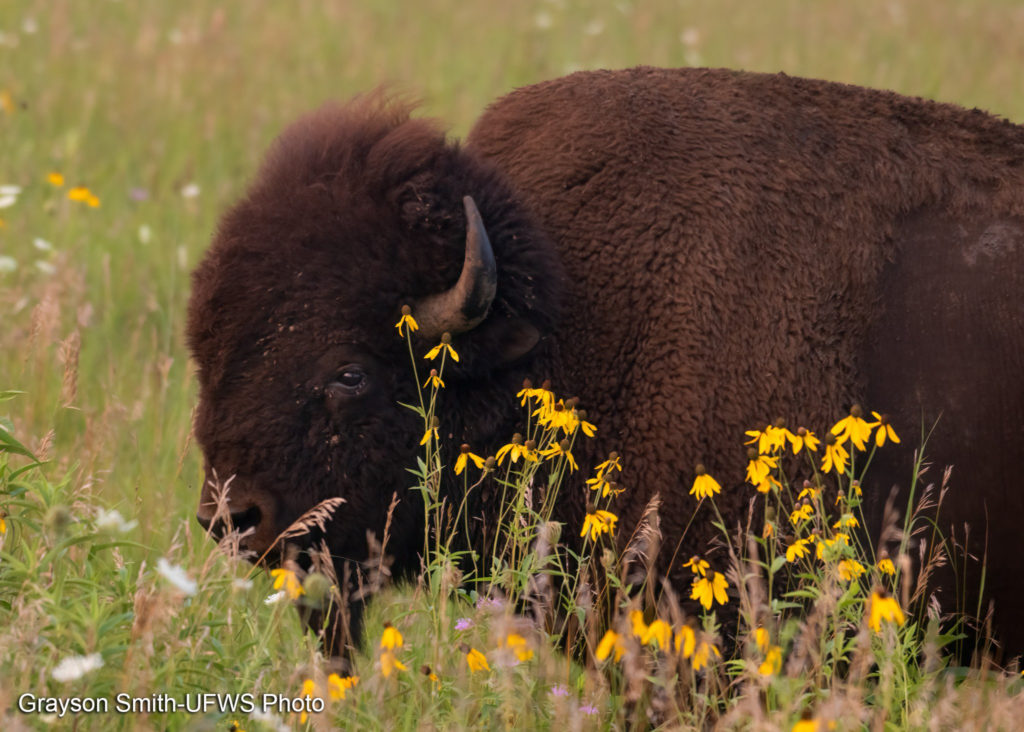
Bison on Tallgrass Prairie at the Neal Smith Wildlife Refuge. Grayson Smith/UFWS Photo

During one of the field trips being offered, you can spend your afternoon at the Neal Smith National Wildlife Refuge, a 6,000 acre reconstructed prairie with bison, elk, rare plant species and other interesting wildlife.

Prairie at Snyder Heritage Farm

The North American Prairie Conference is America’s oldest and most celebrated native grassland conference. The conference is made possible by hundreds of attendees, volunteers, organizations and sponsors, including the Iowa Department of Transportation’s Living Roadway Trust Fund. This year’s co-hosts are the environmentally-minded nonprofits Prairie Rivers of Iowa and Iowa Natural Heritage Foundation.

Attendees can learn more and register at www.northamericanprairie.org. Students can apply for a limited number of scholarships www.iowaprairienetwork.org/napcscholarships.

Members of the media wanting a pass and wishing to attend the conference or any field trips can contact Penny Brown Huber at pbrownhuber@prrcd.org.

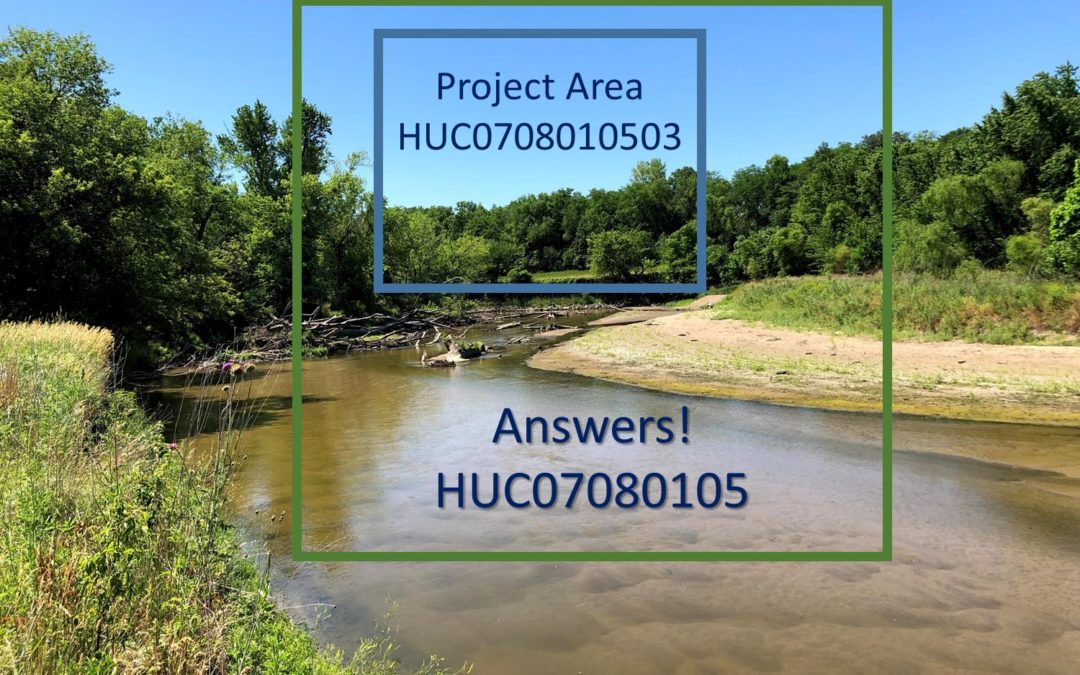
Think Outside the HUCs

Think Outside the HUCs

“With the Nutrient Reduction Strategy approaching its 10-year anniversary in 2023, Iowans deserve to see water quality results from the nearly $100 million of public money invested since 2013.  Water monitoring is a crucial component to the success of the Nutrient Reduction Strategy and must be designed to assess progress.  A strategy without a way to evaluate progress or outcomes is not a real strategy.”

– from Iowa Environmental Council’s 2022 report:  “Water Quality Monitoring and the Water Quality Initiative

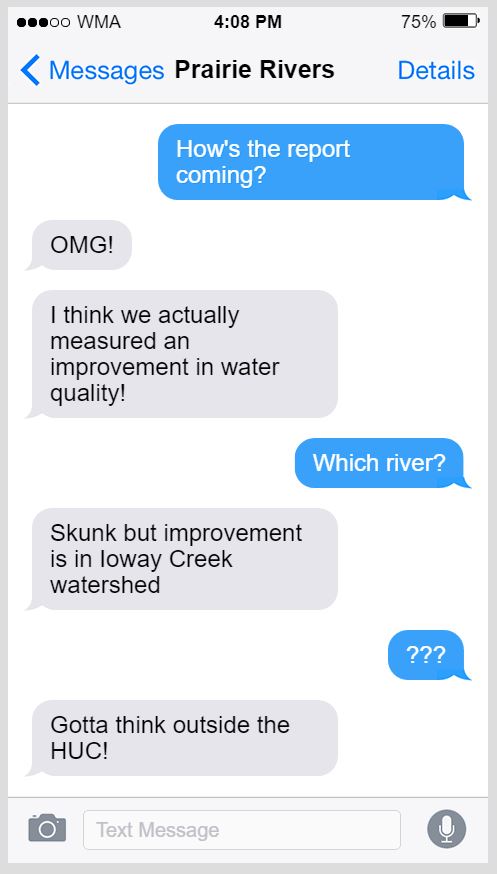
fake text message to introduce blog post

Most water monitoring programs are NOT designed to assess progress.  Often, people don’t begin monitoring in earnest until the grant funding arrives for an improvement project (or on flip side, until an industry with a reputation for pollution sets up shop in the area).  Often, they’re hoping for preliminary results when the grant wraps in 3-5 years.  I’ve been down that road, completed a horrifying statistical analysis, and left this conference poster as a warning to others: “Progress tracking is not a realistic use for typical stream monitoring approaches”.

Our local partners in Story County took this warning to heart and made a plan to sustain water monitoring for at least ten years, while shifting our focus.  We collected lab samples from more sites (less often, and with less hassle) while ramping up the volunteer program, so we could engage the public and get a baseline understanding of water bodies all around the county.  All is well and good.  But now and then I come back to the question “how would you monitor water if you were serious about assessing progress?”.

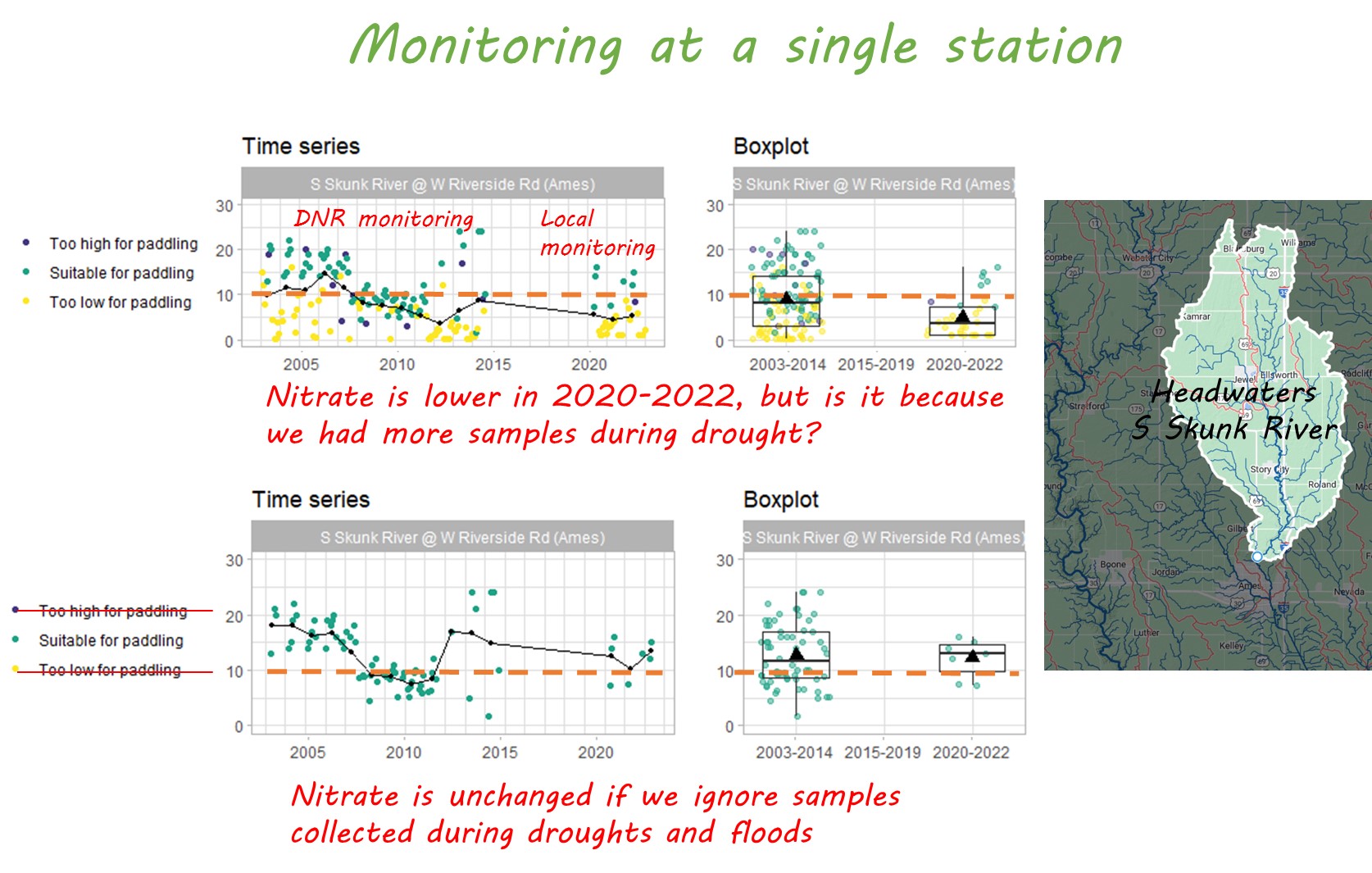
Preliminary results in 3-5 years might be feasible if you already have baseline data for comparison, and account for any big changes in weather.  The South Skunk River just upstream of Ames was monitored from 2001-2014 by the Iowa DNR, and we resumed monitoring it in 2020.  I have good news and bad news for the newly formed Headwaters of the South Skunk River WMA.

  • Good news: average nitrate concentrations over the last three years have declined 46% compared to the baseline period.  Mission accomplished?
  • Bad news: the trend goes away if you exclude samples collected during a drought when nitrate levels are at their lowest.
nitrate trend in south skunk river above Ames

Study design is key for progress tracking.  In order to be sure that water quality really changed, and to be able to link that change to something that happened in the watershed, scientists approach water monitoring like a medical trial.  To do it right, there should be a treatment group (a watershed that receives conservation funding and attention), a control group (a nearby watershed that doesn’t receive funding), a before period, and an after period.  There should be a full accounting of land management and conservation practices in both watersheds.  If the treatment group improves more than the control group, that’s a good sign the medicine works.  At the time we wrote the Story County Monitoring Plan, doing a paired watershed study of the sort that Michelle Soupir did for Black Hawk Lake didn’t make a lot of sense.

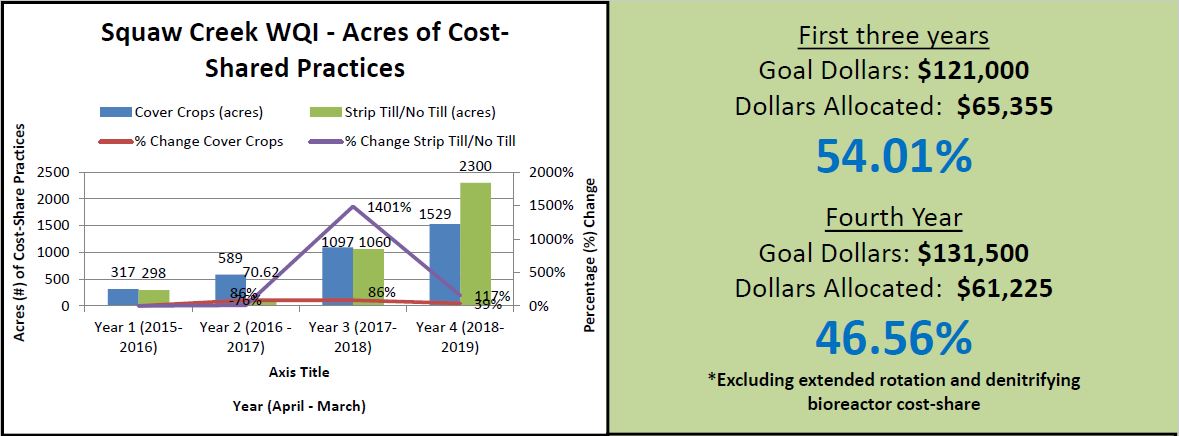
It didn’t make sense to invest in progress tracking, because our WQI-funded watershed project had come to a close, further funding was uncertain, and we couldn’t expect much improvement in water quality based on other metrics to date.  Our watershed coordinators worked really hard, we had enthusiastic partners in local government and agribusiness, and we organized some well-attended field days where we heard from inspiring early adopters of cover crops and bioreactors.  We met some farmers in the watershed who cared enough about soil and water to take a risk and try something new.  Unfortunately, at the end of four years, we had a lot of unspent cost share funds and only enough conservation practices to expect or 1 or 2 percent reduction in nitrogen and phosphorus.  Ioway Creek is a big watershed (147,000 acres).

metrics from wqi project

However, this year I was reviewing our water monitoring data and had one of those moments like when you squint at an optical illusion and suddenly see a rabbit instead of a duck.

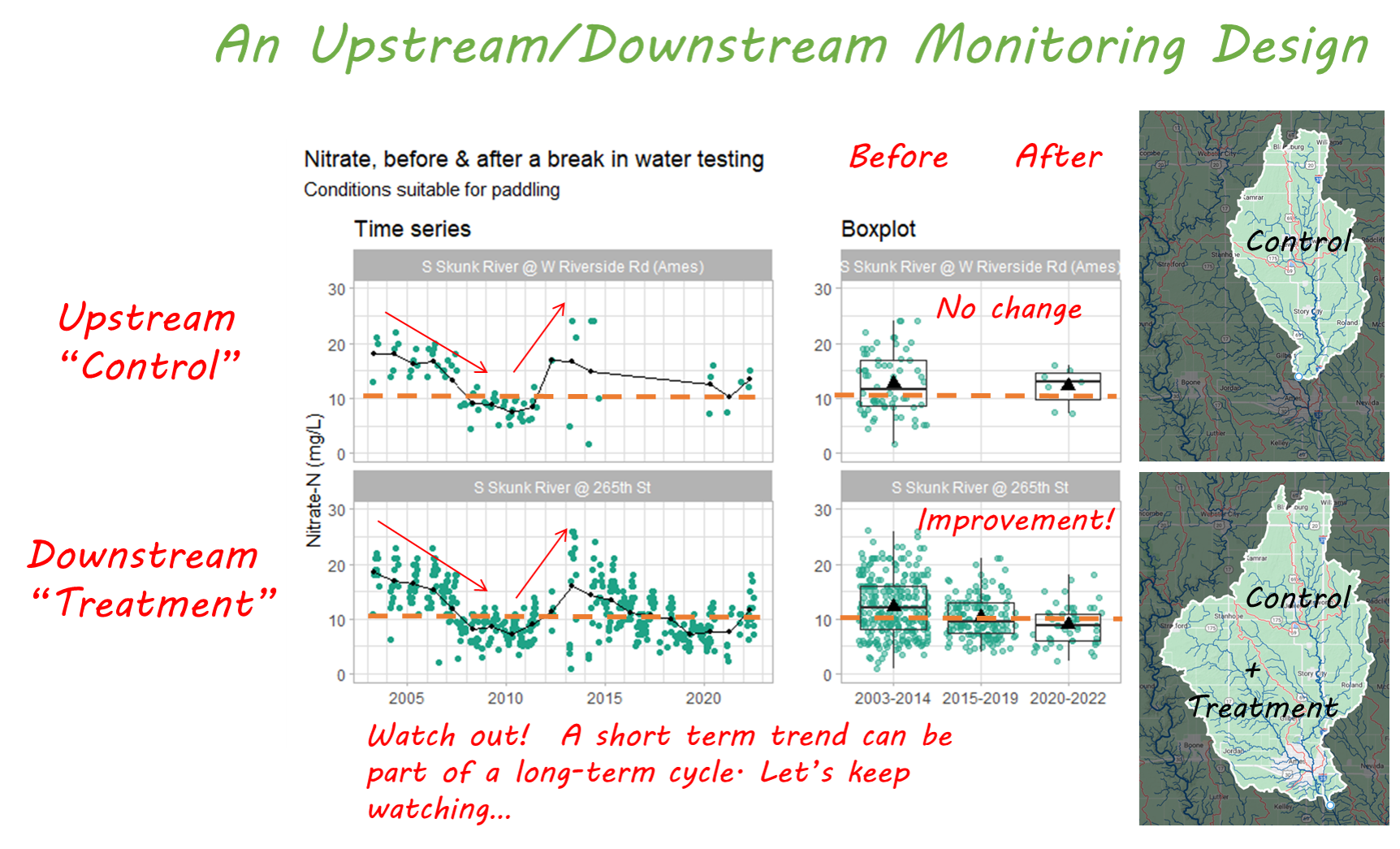
“Hey, that looks a lot like an upstream/downstream study for tracking whether projects in the Ioway Creek watershed and the City of Ames have improved water quality!”

  • The medicine: A bunch of conservation practices were installed between 2015 and 2019, some of which address nitrogen and some of which address other pollutants. We could include Jean’s no-till fields in Hamilton County, Jeremy’s cover crops in Boone County, Gerold’s bioreactor in Boone County, the UV disinfection system in Gilbert, the permeable parking lot at Ames City Hall, the stream restoration and saturated buffer at the Tedesco Environmental Learning Corridor, and many others.
  • The treatment group: A downstream site, influenced by all those conservation practices. The South Skunk River at 265th St. has been monitored weekly by the City of Ames since 2003.  At this point the river drains 573 square miles, corresponding to the Ioway Creek watershed plus the Headwaters of the South Skunk River watershed.
  • The control group: An upstream site, not influenced by these practices. At this point, the river drains 316 square miles, corresponding to the Headwaters of the South Skunk River watershed, minus any land within Ames city limits.
  • A before period: Both sites were monitored between 2003 and 2014.
  • An after period: Both sites were monitored between 2020 and 2022.

And then I made a boxplot and squinted a little more and said, “Hey, it looks a lot like nitrate has improved at the downstream site!”  Same thing for E. coli!  Maybe there’s more to this story than just cost-share metrics.

graphs comparing nitrate at upstream and downstream sites

The analysis is described in more detail in our 2022 annual report on water monitoring in Story County.  We’ll also have some opportunities this year to talk with other groups around the state that are doing water quality monitoring and swap some tips and tricks.

Here’s one of mine. To see the “rabbit” in this data, you have to be flexible in how you think about watersheds.  A watershed is just the land area that drains to a common point.  With the right tools, we can delineate a watershed for any point of interest on the river network.  I’ve taught several classes of ninth graders how to do this.  Neither of these sites are in the Ioway Creek watershed, and they aren’t mentioned in the Watershed Plan, but that doesn’t mean they’re not relevant.  The US Geologic Survey’s system for mapping and numbering watersheds is convenient for many purposes.  But if you have access to long-term monitoring data, don’t be afraid to think outside the HUCs!

Trees for the Bees: How to Support Wildlife this Arbor Day!

Trees for the Bees: How to Support Wildlife this Arbor Day!

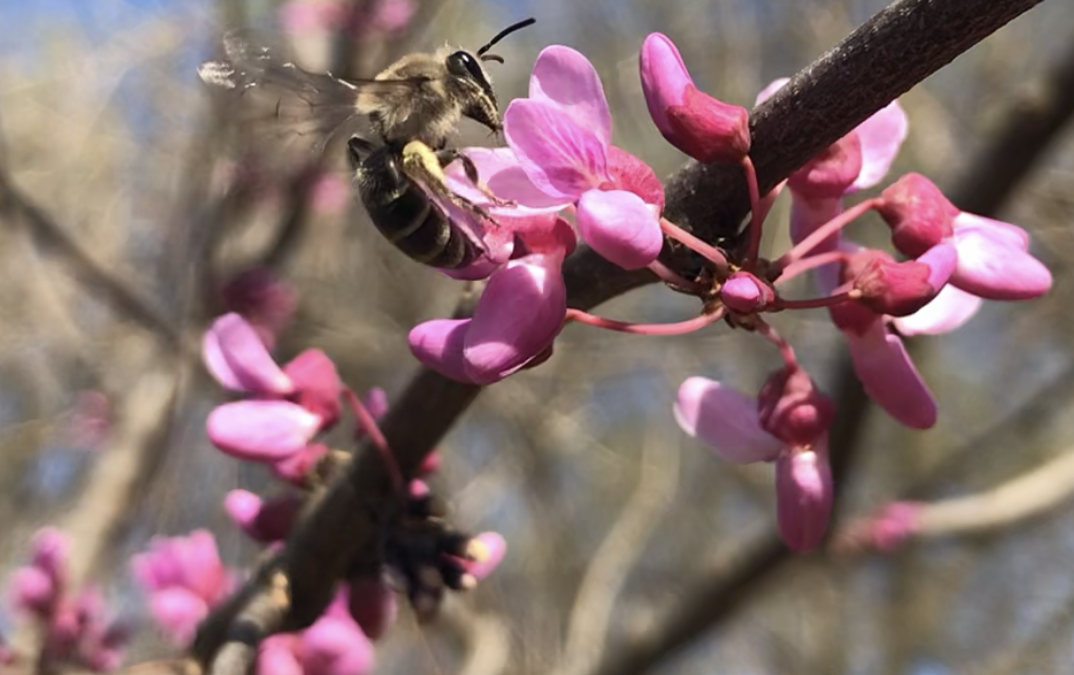
A native bee visiting a redbud tree.

These warmer days make it hard to sit still; we all want to get a jump on our yard and garden plans! Maybe you’re thinking of adding some small pockets of pollinator habitat. Or perhaps you’ve finally decided to add a tree or two for shade. While there’s a dizzying number of guides for “pollinator flowers”, there’s less advice on how homeowners can utilize trees and shrubs to support wildlife.

Planting a tree can be an investment not only of money but of time as well. When thinking about the long-term goals for your property, it’s important to think about the legacy you want to leave behind, as the tree may outlive you. Planting the right trees can not only increase your property’s appeal; it can also provide habitat for songbirds and pollinators for decades to come! So which trees are attractive to pollinators, are native to Iowa, and look great in our yards? We’ve put together a list to answer some of these questions, just in time for Arbor Day, which falls on April 28 this year!

But first: why trees?

Native trees and shrubs provide excellent wildlife habitat in several ways. Many provide an early flower source for pollinators such as bees and butterflies, and they are also great habitat for birds! Trees provide nesting and hiding areas for birds, and can attract insects that birds need to feed their chicks (more on that later). Planting native trees will especially invite butterflies and moths to visit your yard and lay their eggs, which hatch into caterpillars. These caterpillars then snack on tree and shrub leaves (they won’t do any real damage) until they spin their chrysalises or get plucked by a bird. Caterpillars and other insects are fundamental to the food web: they are the juicy, protein-filled link between plants and larger animals. If you want to see beautiful butterflies and songbirds, you should plant native trees that support native insects!

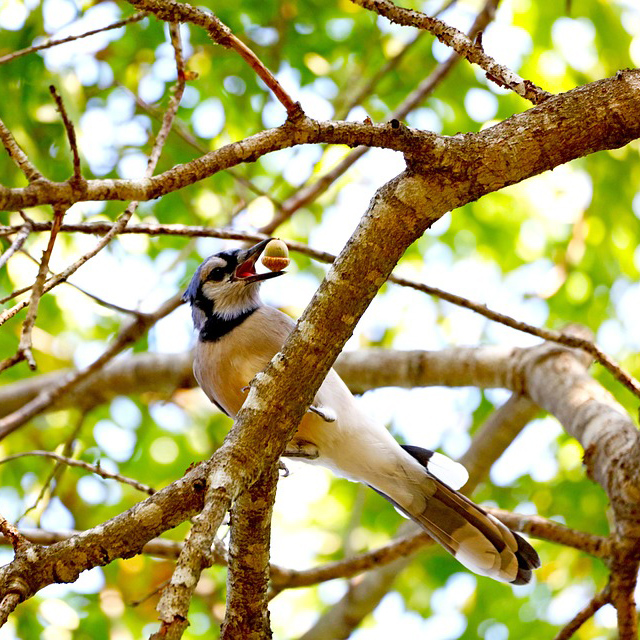
A blue jay with an acorn.

Native trees are central to an exciting, diverse yard!

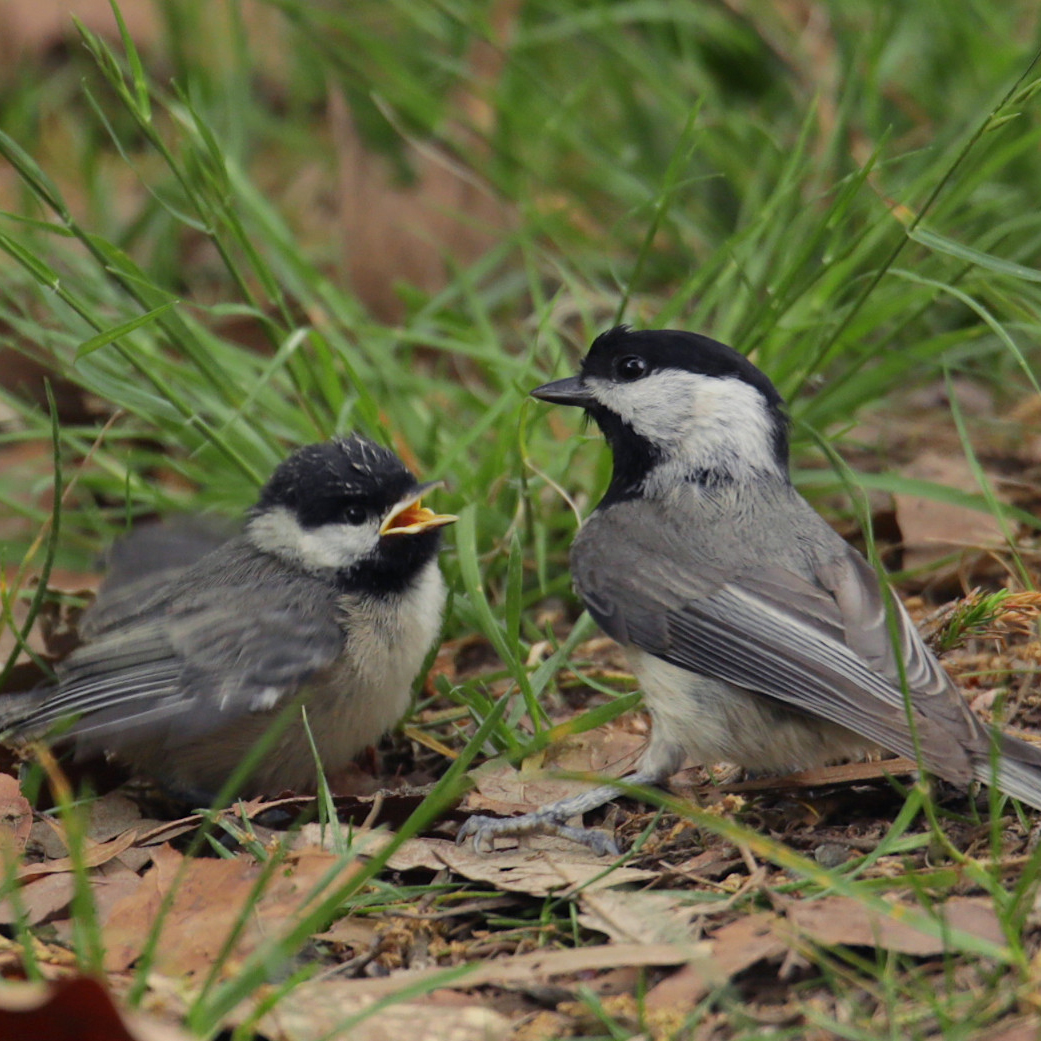
The nonnative ginko tree (the one with fan-shaped leaves) supports about 4 species of caterpillars. In contrast, native oak trees alone can support 534 species of caterpillars (according to Dr. Doug Tallamy*). Consider the fact that black-capped chickadees need at least 300 caterpillars a day to feed their chicks – that’s about 5,000 caterpillars needed in a few weeks while the chicks grow! And this is just one example. Imagine if you had three chickadee families in your yard, or five other species of birds visiting your feeders. Suddenly, native trees just seem practical, and planting nonnative trees, such as a ginko, seems, as Tallamy put it, “equivalent to erecting a statue” in terms of its usefulness.

A young chickadee and parent.

Unhelpful trees:

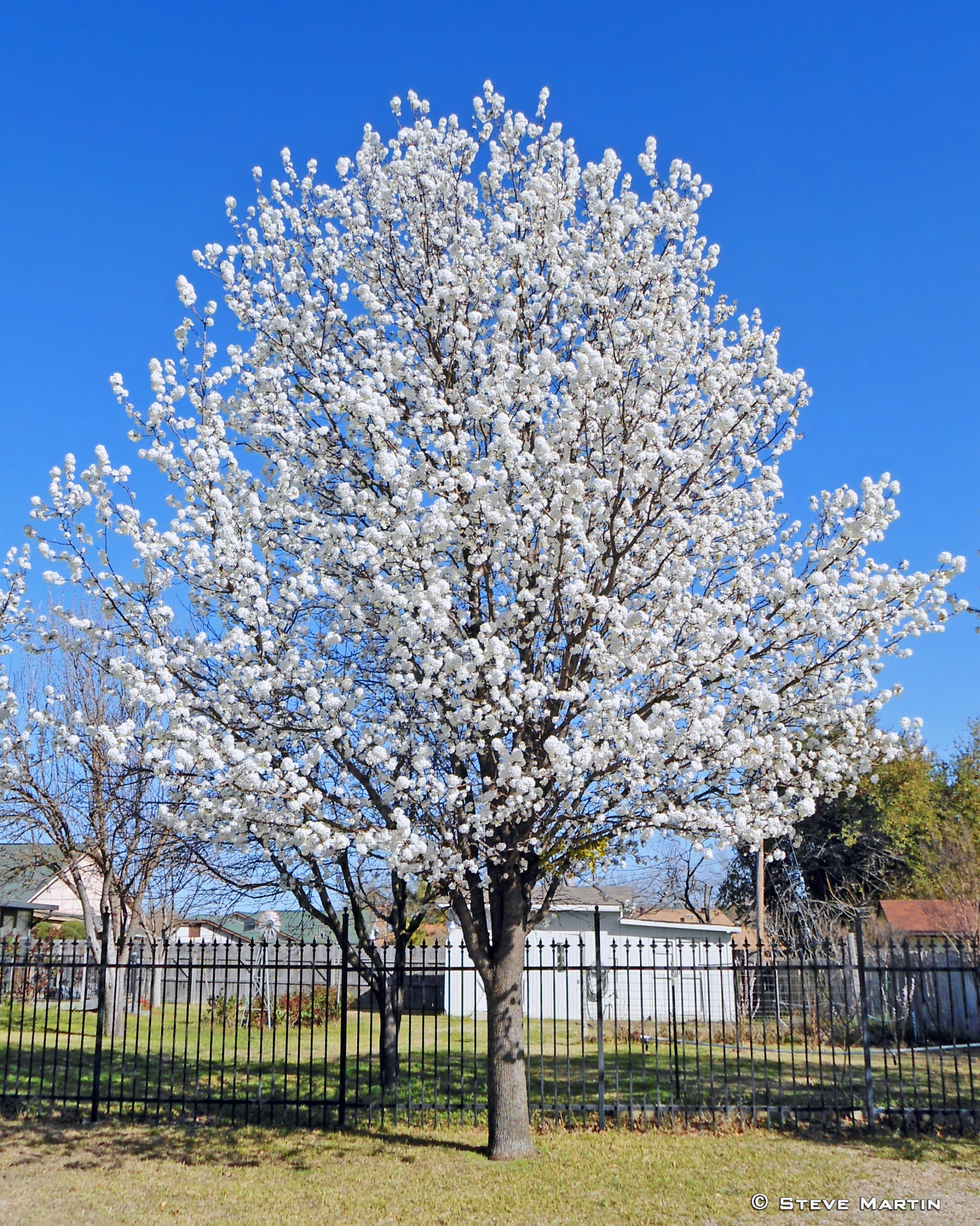
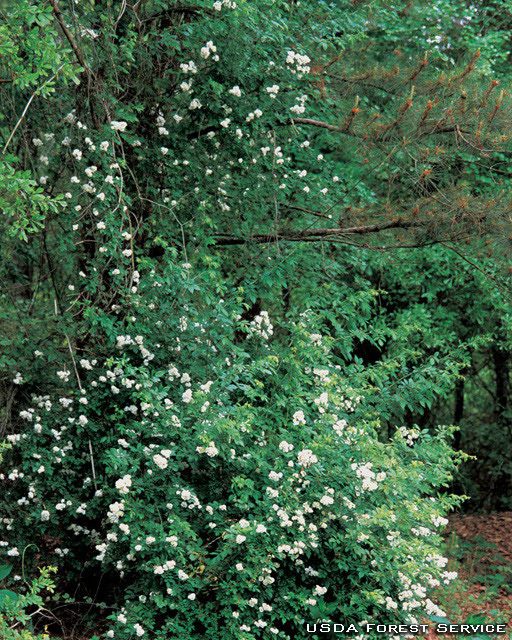
Let’s address the elephant in the room: some trees and shrubs commonly planted in yards are pretty damaging; they easily spread from our yards and choke out native plants that wildlife depend upon, and cost cities and counties thousands of dollars to remove from natural areas and building foundations (some of these trees’ roots can actually compromise the integrity of buildings). Some trees and shrubs to stay away from include: Bradford or Callery pear trees (Pyrus calleryana; also their flowers smell bad), Norway maples (Acer platanoides), buckthorn (Frangula species), multiflora rose (Rosa multiflora), tree of heaven (Ailanthus altissima), and Amur and Morrow’s honeysuckle (Lonicera maackii and L. morrowii, respectfully).


Lastly, do your best to avoid planting cultivars and hybrids that promise better color, bigger flowers, etc. Most native trees (especially maples) produce spectacular fall color anyway, and the hybrids you see in the nurseries will likely be sterile, and won’t produce flowers that attract pollinators or birds (if they produce any at all). It is also important to note that nonnative shrubs, trees, and hybrids may tout that they produce berries, and therefore support wildlife. Birds in particular may feed on berries only certain times of the year, and that time may not coincide with berry production on hybrid plants. Additionally, these nonnative plants will not come close to supporting the number of caterpillars needed to keep birds nesting in or near your yard.

Bradford pear tree with smelly flowers.

Multiflora rose choking out trees.

Now for the main event: the best shrubs and trees to plant!

How the lists are set up: Shrubs, small trees, and larger trees that are native to Iowa and beneficial to pollinators are listed below in order of bloom time. Each table describes a specific genus or species of tree, which is pictured to the right of the table (or below in mobile format).

Shrubs and small trees are listed first, and larger trees are listed afterwards. A small picture of the blooms produced by a shrub or tree may be displayed in the corner of the picture of the mature plant. These are not exhaustive lists; they are meant to get you started!

{ See end of article for a list of places to purchase native shrubs and trees! }

Shrubs


The following native plant species are shrubs and small trees reaching a maximum height of 30 feet. These trees are perfect for small yards, or large yards that want to add visual interest and diversity by planting trees of varying heights. Some of these shrubs also make great hedges or borders near property lines! Be sure to look up how some of these shrubs spread to make sure their maintenance needs meet your expecations.

Common NameBloom PeriodSun and Soil Needs
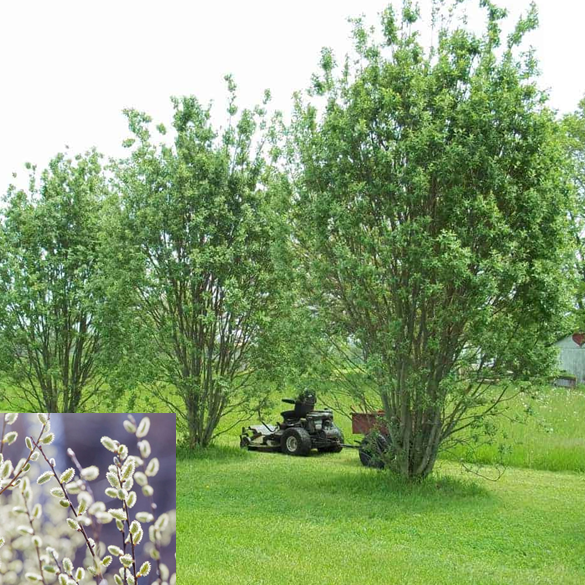
Pussy WillowEarly to Mid-SpringFull Sun, Wet – Moist
Species NameBloom LengthWildlife Supported
Salix discolor2 WeeksPollinators, Birds
Max HeightBloom DescriptionFall Color
6 – 20 ftSmall, fluffy white catkinsDull green – yellow


Butterfly weed
Common NameBloom PeriodSun and Soil Needs
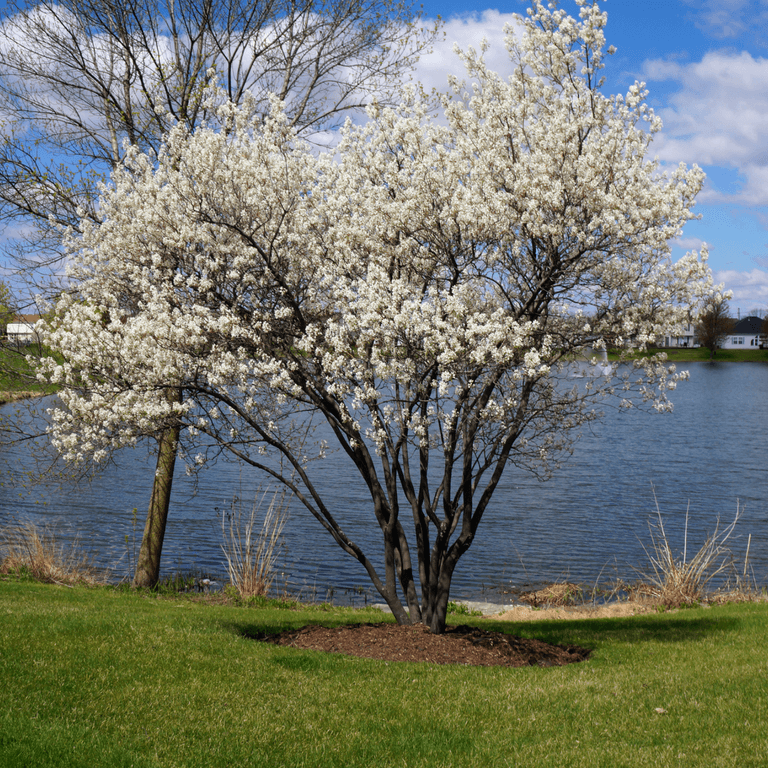
Serviceberry (Juneberry)Mid-SpringPart – Full Sun, Moist – Dry
Species NameBloom LengthWildlife Supported
Amelanchier arborea1 – 2 WeeksPollinators, Birds, and more
Max HeightBloom DescriptionFall Color
6 – 20 ftWhite, 1-inch flowersRed-orange


Butterfly weed
Common NameBloom PeriodSun and Soil Needs
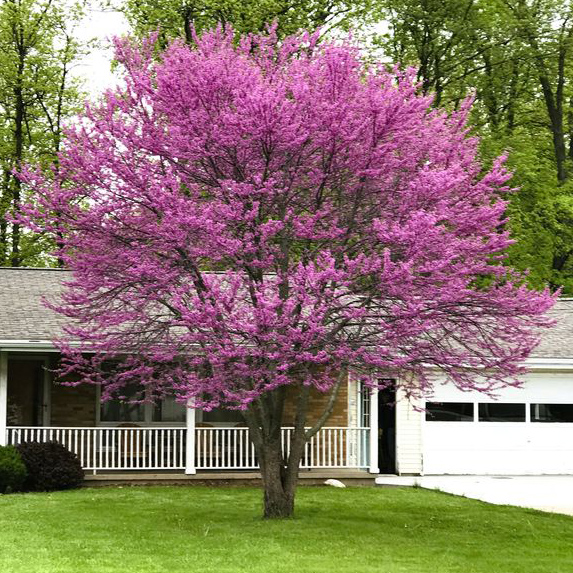
Eastern RedbudMid-SpringPart – Full Sun, Moist – Dry
Species NameBloom LengthWildlife Supported
Cercis canadensis4 WeeksPollinators
Max HeightBloom DescriptionFall Color
15 – 25 ftShowy pink flowersYellow


Butterfly weed
Common NameBloom PeriodSun and Soil Needs
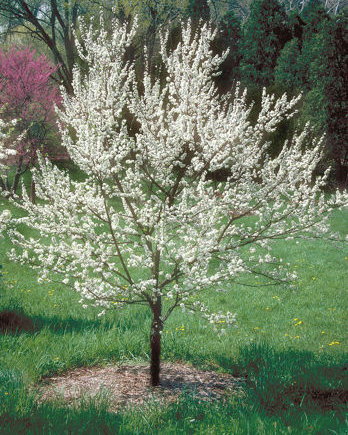
American PlumMid- to late SpringPart – Full Sun, Medium
Species NameBloom LengthWildlife Supported
Prunus americana2 WeeksPollinators, Mammals
Max HeightBloom DescriptionFall Color
10 – 15 ftShowy white flowersRed to Yellow


Butterfly weed
Common NameBloom PeriodSun and Soil Needs
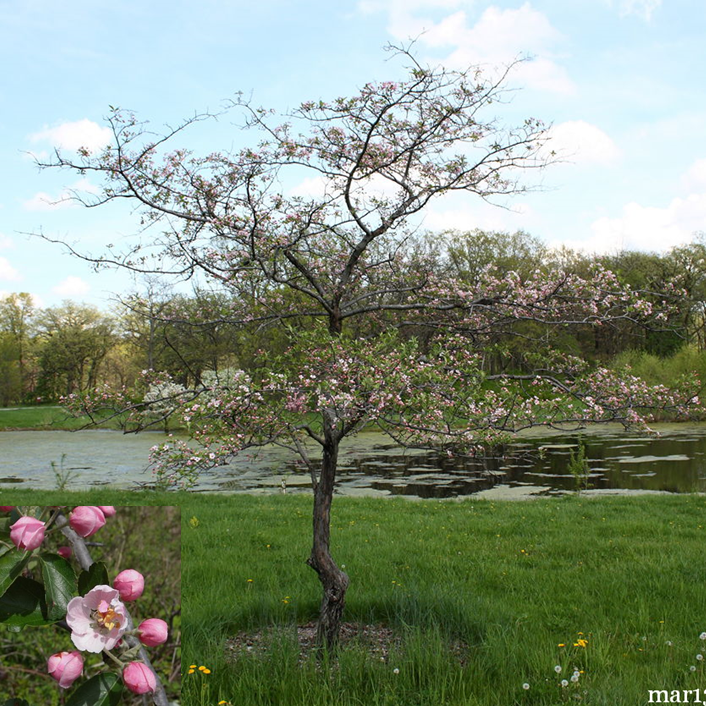
Prairie Crab AppleLate SpringPart – Full Sun,  Moist – Medium
Species NameBloom LengthWildlife Supported
Malus ioensis1 – 2 WeeksPollinators, Birds, and more
Max HeightBloom DescriptionFall Color
10 – 25 ftShowy white-pink flowersBrown-orangeish


Butterfly weed
Common NameBloom PeriodSun and Soil Needs
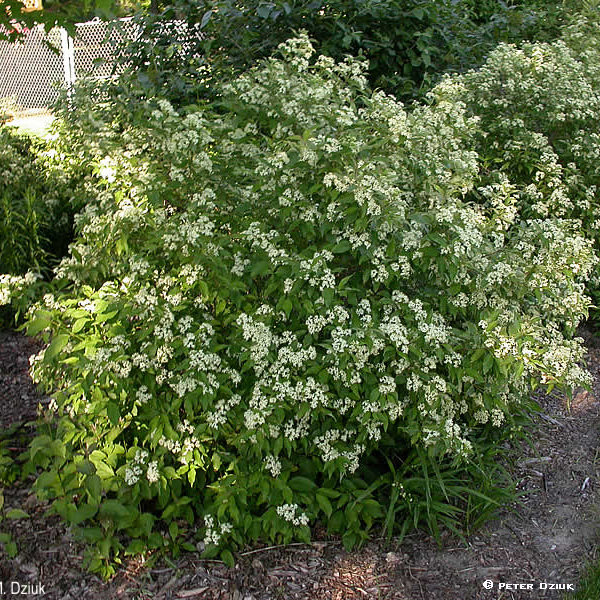
Gray DogwoodLate Spring to Mid-SummerPart – Full Sun,  Moist – Medium
Species NameBloom LengthWildlife Supported
Cornus racemosa3 WeeksPollinators, Birds, and more
Max HeightBloom DescriptionFall Color
8 – 15 ftShowy white flowersRed-purple


Butterfly weed
Common NameBloom PeriodSun and Soil Needs
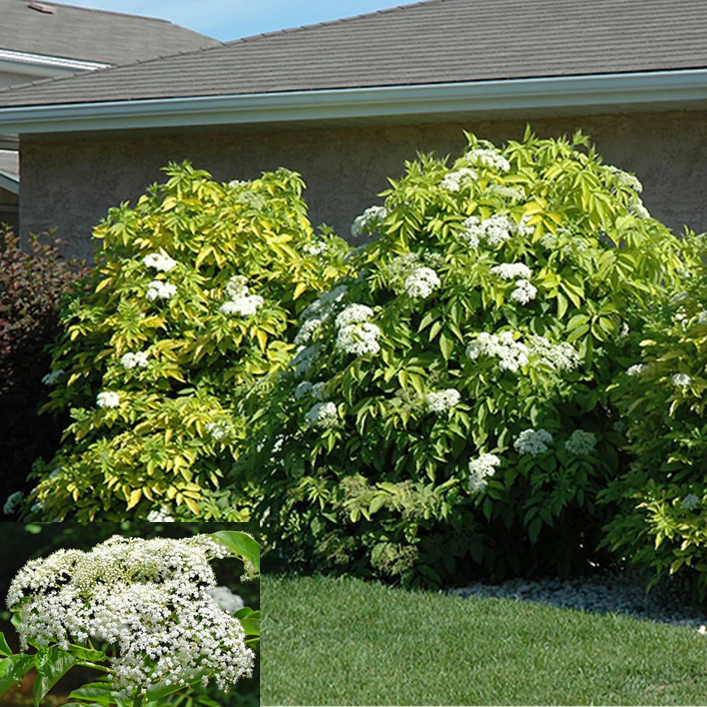
American ElderberryLate Spring to Mid-SummerPart – Full Sun, Moist
Species NameBloom LengthWildlife Supported
Sambucus nigra canadensis, or Sambucus canadensis3 – 4 WeeksPollinators, Birds
Max HeightBloom DescriptionFall Color
4 – 12 ftShowy white flowersBrown-reddish to Yellow


Butterfly weed

Trees


The following species are taller native trees ranging from 40 to 120 feet tall. These trees will provide high-quality habitat in larger yards, and are sure to attract and support wildlife, especially if mutlitple species are planted. Be sure to check if these trees create any fruits or seed pods so you can determine which trees best match your expectations.

Common NameBloom Period Sun and Soil Needs
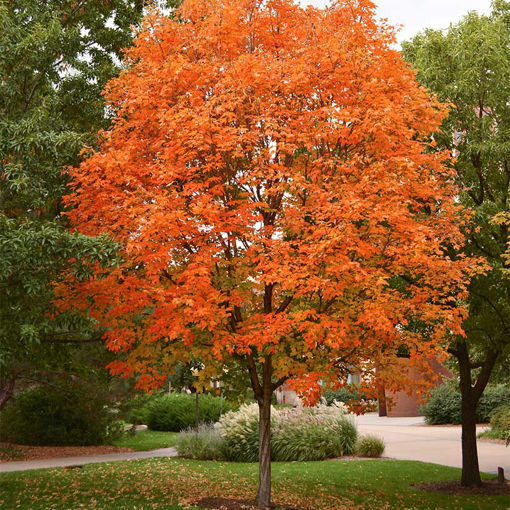
Maples (Sugar, Black, and others)Early to Late SpringPart – Full Sun, Medium
Species NameBloom LengthWildlife Supported 
Acer species1 – 2 WeeksPollinators, Birds,  and more
Max HeightBloom DescriptionFall Color
60 – 100 ftSmall yellow-green flowersStriking colors, varies by species
Bicknell's sedge

Sugar Maple (Acer saccharum)

Common NameBloom Period Sun and Soil Needs
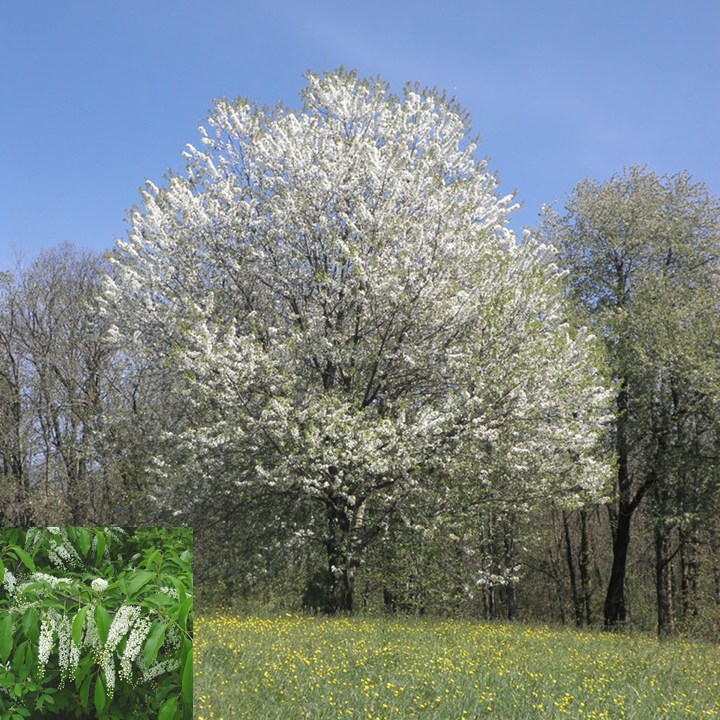
Black CherryLate Spring to Early SummerPart – Full Sun,    Moist – Dry
Species NameBloom LengthWildlife Supported 
Prunus serotina2 – 3 WeeksPollinators, Birds,  and more
Max HeightBloom DescriptionFall Color
50 – 80 ftShowy white flowersYellow to reddish
Bicknell's sedge
Common NameBloom Period Sun and Soil Needs
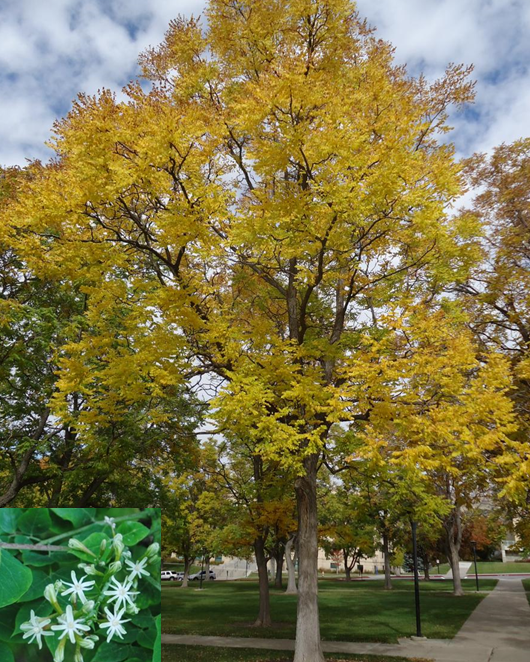
Kentucky CoffeetreeLate Spring to Early SummerPart – Full Sun,    Moist – Medium
Species NameBloom LengthWildlife Supported 
Gymnocladus dioicus2 – 3 WeeksPollinators, Birds
Max HeightBloom DescriptionFall Color
60 – 90 ftSmall white flowersYellow
Bicknell's sedge
Common NameBloom Period Sun and Soil Needs
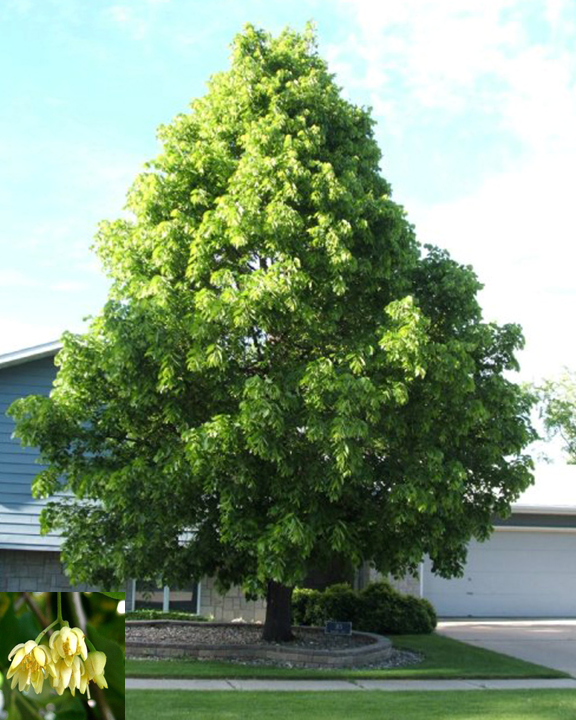
Basswood (Linden)Early SummerPart – Full Sun,    Medium
Species NameBloom LengthWildlife Supported 
Tilia americana2 WeeksPollinators
Max HeightBloom DescriptionFall Color
50 – 100 ftSmall white flowersDull green – yellow
Bicknell's sedge
Common NameBloom Period Sun and Soil Needs
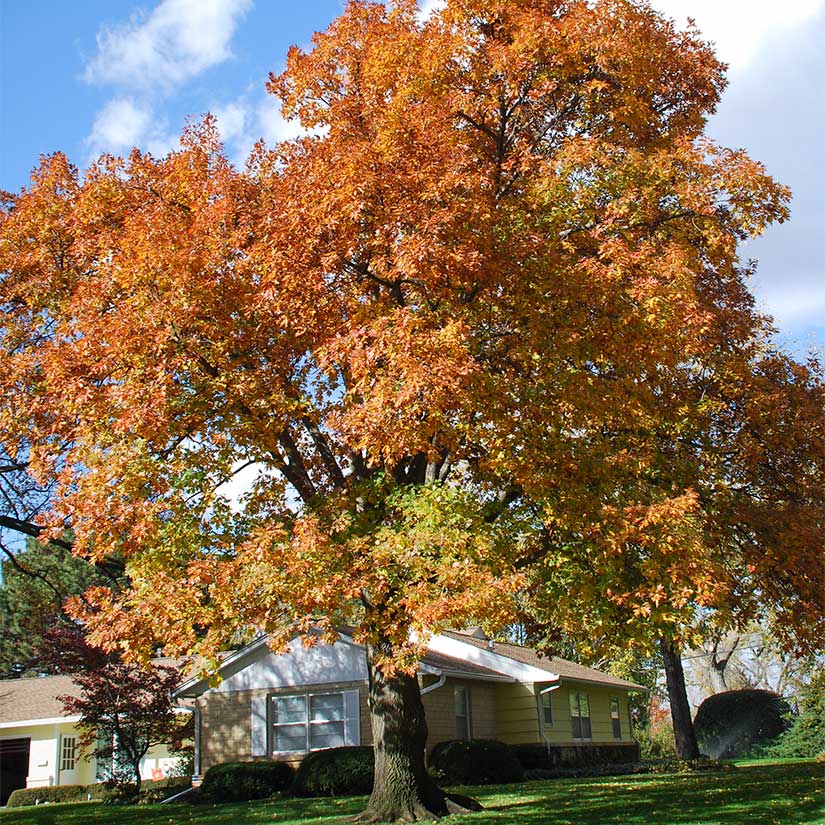
Oaks (Red, White, and others)VariesVaries
Species NameBloom LengthWildlife Supported 
Quercus speciesVariesInvaluable to countless wildlife
Max HeightBloom DescriptionFall Color
40 – 80 ftVariesDull to striking colors
Bicknell's sedge

Northern Red Oak (Quercus rubra)

* = According to research by Dr. Doug Tallamy, author and faculty member at the University of Delaware.\

This article used a number of resources, including:

Ladybird Johnson Wildflower Center                                      Michigan Department of Natural Resources

Missouri Botanical Garden                                                         Michigan State University

University of Minnesota Extension                                            USDA NRCS PLANTS Database


Some great native shrub and tree nurseries:


The State Forest Nursery: Ames, Iowa.  1-800-865-2477 or 515-233-1161

Iowa Native Trees and Shrubs: Woodward, Iowa. 515-664-8633

Blooming Prairie Nursery: Carlisle, Iowa. 515-689-9444

Happy Arbor Day, and happy tree planting!

Clover Lawns: Is the Trend Lucky for Pollinators?

Clover Lawns: Is the Trend Lucky for Pollinators?

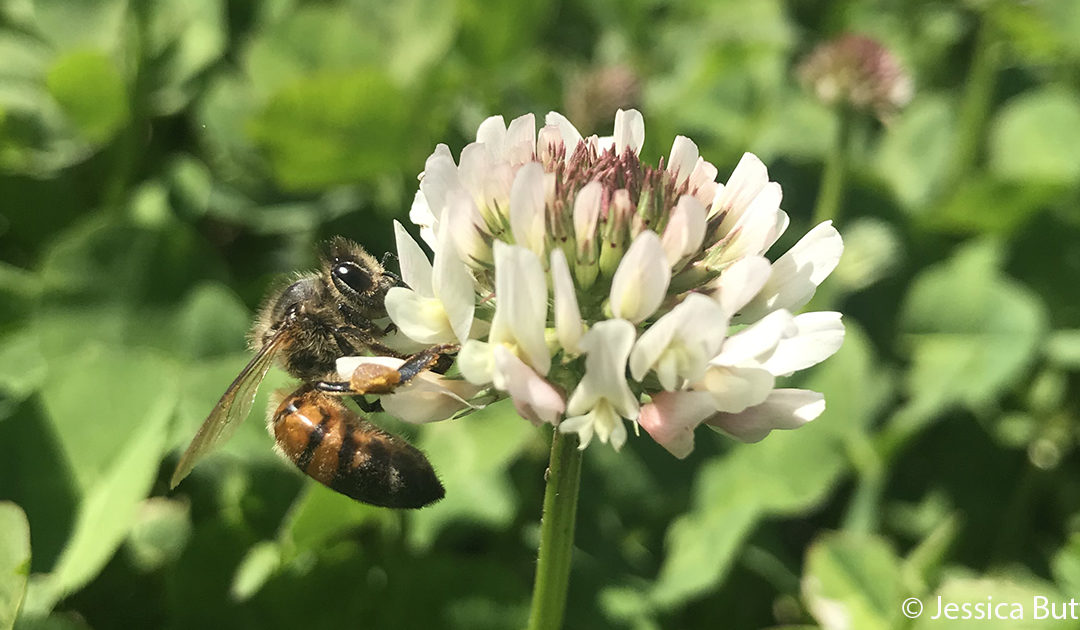
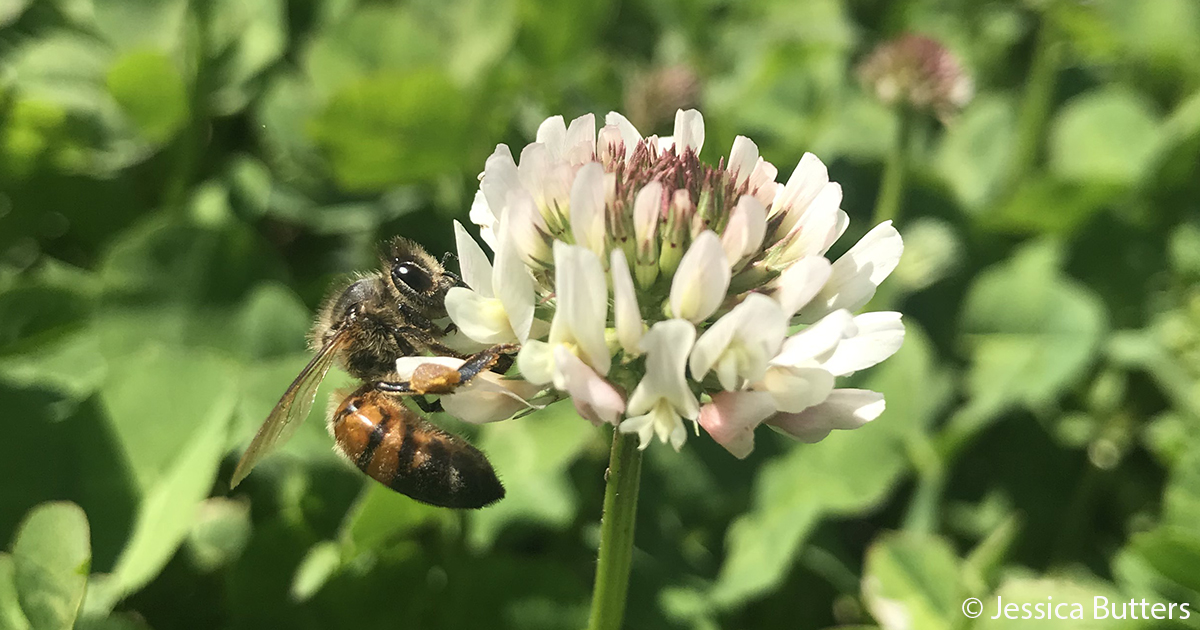
A honey bee visits a clover flower.

The idea of creating a pollinator-friendly yard is finally taking root, and the notion of a perfect lawn, along with its expense, is being weeded out. Clover lawns are one of the latest trends yard owners are trying out in an effort to be more environmentally conscious. This new kind of lawn is often touted to support pollinators, require less up-keep, and lower pollution. But do they live up to the hype?

What is a clover lawn?

What constitutes a “clover lawn” has several renditions. The simplest form of a clover lawn is a lawn in which someone passively allowed clover to establish and grow. They stopped spraying herbicides, mowed less, and allowed grass to die in areas, giving way to clover and other plants. A second kind of clover lawn is one in which clover was actively seeded into the lawn, over the existing turf (this was a common practice until the 1950s). A third way of creating a clover lawn is to kill and remove all turf and replace it entirely with clover, resulting in a uniform lawn.

Common clovers used for lawns are nonnative, including white (Dutch) clover (Trifolium repens) and strawberry clover (Trifolium fragiferum), both hailing from Eurasia. Strawberry clover is also the species included in the Scotts®Turf Builder® Clover Lawn seed. The idea of seeding mini or micro clovers is increasingly popular. These clovers are normally short-statured cultivars of the species listed above. Micro clover lawns are supposed to require even less maintenance and have smaller flowers that attract fewer bees. There are no readily-available native clovers that are marketed for clover lawns (though there are some fantastic native clovers in Iowa).

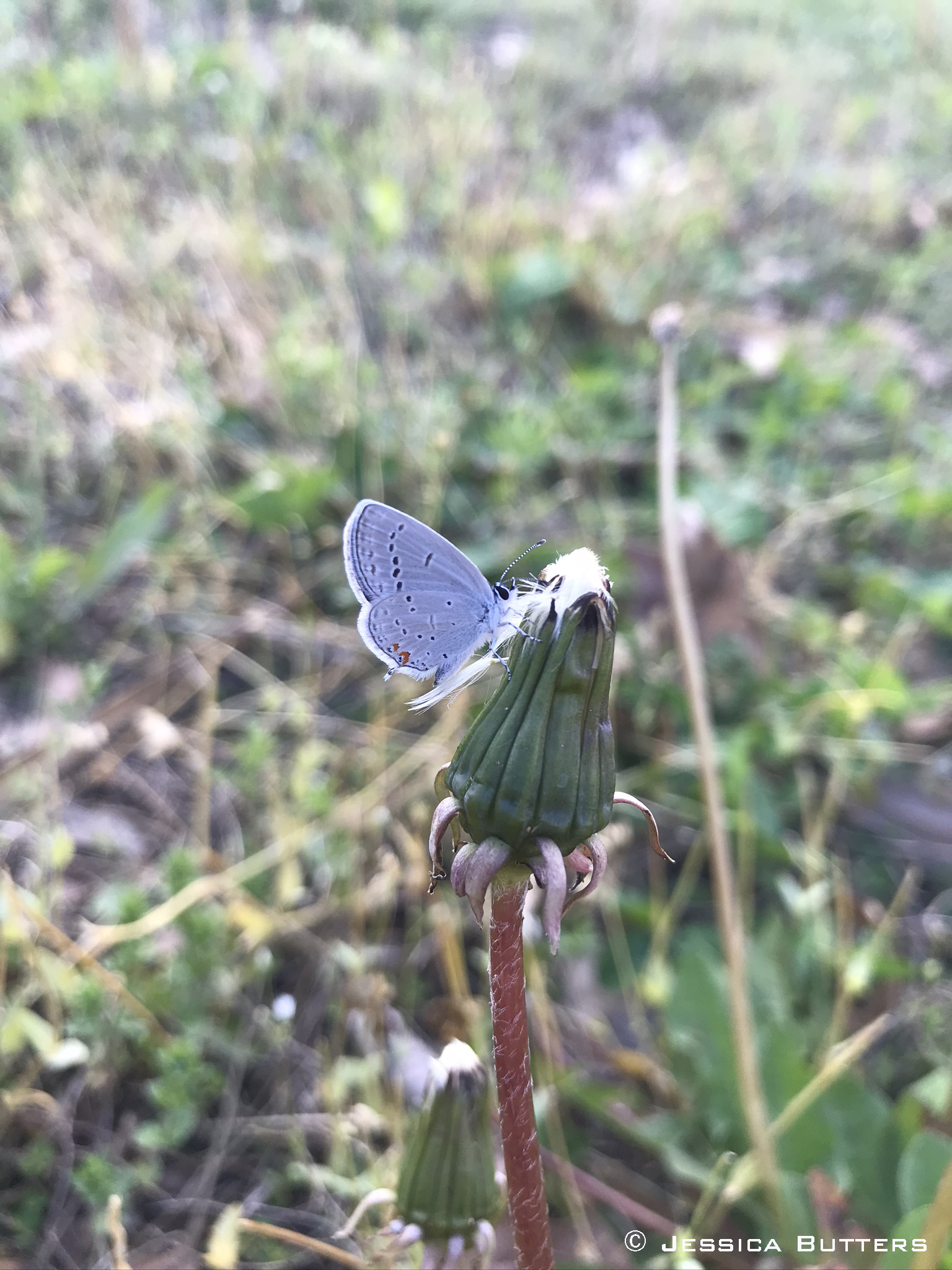
A hairstreak butterfly on a dandelion.

Why would you want a clover lawn?

Those interested in clover lawns will have different objectives. Some are drawn to the fact that most clovers require less care than turf grasses (though they still require regular maintenance). Clovers usually need less mowing, resist weeds, many are drought- and shade-tolerant, and they also fix nitrogen in the soil, eliminating the need for fertilizer. These attributes are also welcomed by those looking to reduce carbon emissions and pollution by requiring less mowing, herbicides, and fertilizers. Lastly, wildlife lovers hope to support pollinators with clover due to the fact that their flowers can attract honey bees and some native bees. However, keep in mind that these positive attributes are good only in comparison to a traditional turf-grass lawn, which provides scant (if any) environmental benefits and requires a lot of maintenance. Additionally, clover does not stand up to heavy foot traffic as well as grasses, and may need to be reseeded every two or three years.

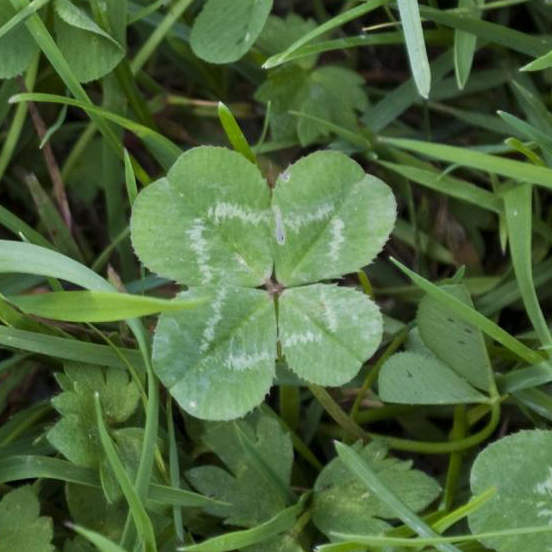
A lucky four-leaf clover.

A lucky four-leaf clover.

Luna Moth

A native bee visiting nonnative clover.

Do clover lawns benefit pollinators?

Simply put, some clover lawns can provide benefits to some pollinators. If you really want a clover lawn, the best method for wildlife (and your wallet) is to passively allow clover to enter your lawn. This practice requires you to mow less and stop using herbicides, which will keep pollinators in your area healthier.

While there are some benefits to having a clover lawn, they are small from a broader point of view. At the end of the day, adding clover to your lawn adds a few species of nonnative plants in your area, which often provide sub-optimal nutrition to native pollinators. Keep in mind that many pollinators are specialists and will not visit nonnative clover. Additionally, it may be difficult to keep the clover on your own lawn, and out of natural habitats. In contrast, planting a pollinator garden, even a small one, adds multiple native flower species and provides high-quality habitat to native pollinators. Planting within a garden also doesn’t require you to rethink your entire lawn. Finally, a garden is a stronger challenge to the status quo, as planting a diverse and beautiful garden is a lot harder to be annoyed about than nonnative dandelions and clover in your front yard. It is better PR for pollinator habitat: a neighbor with a more traditional mindset for a lawn will not appreciate the spread of “weeds”, but may be open to the idea of creating their own native plant garden.

Are clover lawns worth it?

In my personal opinion, ideas such as clover lawns challenge the current lawn standard, but are not the end goal. They also do not entirely live up to the hype: they still require maintenance, and are not the seed-and-forget or “let it go” solution that many were hoping for. From this point of view, you might as well grow native plants.

From an environmental standpoint, we need more native habitat and less lawn, whether it’s traditional or clover. It would be a more effective and meaningful trend to encourage people to grow “micro gardens” for pollinators instead of praising micro clovers and other nonnative lawn alternatives. To make the biggest impact in your corner of the world, ending pesticide use and planting a native plant garden (even a tiny one!) is best. However, if that kind of project is not possible for you at the moment, ending all pesticide use and choosing to mow less often is definitely “better than nothing”. Doing so will probably invite clover into your lawn, which will suffice until you can start a small garden. The clover trend is not lucky for all pollinators, but a garden that includes native clovers could be!

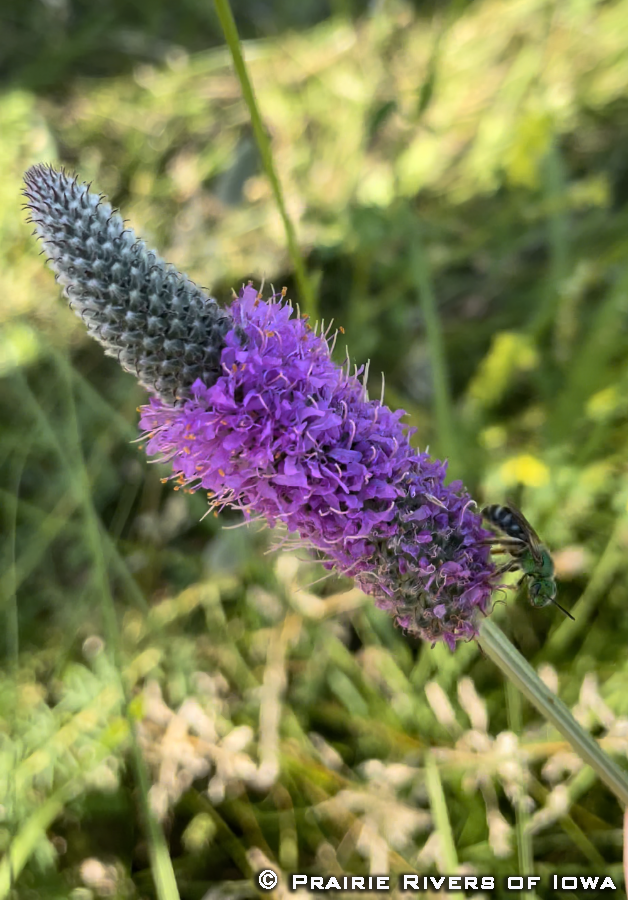
A sweat bee visiting a native clover.