


Iowa’s E. coli Problem: Tracking the Source with DNA Forensics
It’s no secret that Iowa’s waters are in rough shape. Nitrate is on the news, beaches are closed, the list goes on. Just take a look at the Iowa DNR Impaired Waters report for 2026. As the graph on the right shows, over half of the assessed river and stream reaches in the state are impaired. That means the water body doesn’t meet federal standards for its designated use. That figure doesn’t even include the 1099 “Not Assessed” segments or the 254 “WINOFI” segments (waters in need of further investigation).
What might surprise you is the leading cause of the impairments. It’s not nitrate or toxic algae or even pesticides. It’s E. coli, and it’s not even close. Of the 747 individual impairments cited in the 565 impaired segments, roughly 430 were due to E. coli (listed in the report as “indicator bacteria”).

Iowa DNR Impaired Waters Assessment Results. Top chart shows the results for assessed streams, including WINOFI (waters in need of further investigation). Bottom chart shows assessment status for all waters.
Source: Iowa DNR 2026 305(b) Assessment Summary DRAFT.

Iowa DNR Impaired Waters Assessment Results. Chart shows count of impairment causes across all impaired streams and river segments. “Category” refers to EPA Integrated Report Categories: *Category 4: Waterbody is impaired or threatened but a TMDL (total max. daily limit) is not needed. Category 5: Waterbody is impaired or threatened and a TMDL is needed.
Source: Iowa DNR 2026 305(b) Assessment Summary DRAFT.
What about Story County?
While the number of state-monitored stream segments has increased in recent years, the health of most segments remain unknown. To help fill this data gap, Prairie Rivers of Iowa (PRI) samples local streams and rivers with help from the City of Ames and Story County Conservation.
This summer we took 60 samples from 13 Story County streams. Fifty-eight of them exceeded Iowa’s single-sample maximum for primary (A1) and children’s (A3) recreation, which is 235 E. coli/100 mL. Thirteen of those also exceeded the much looser secondary recreation (A2) maximum of 2,880/100 mL. Three were too high to measure, above 23,000 MPN per 100 mL.
The Iowa DNR does not recognize PRI’s E. coli data as sufficient quality to assess stream status because we do not meet Iowa’s credible data requirements for an approved quality assurance plan. If it did, our results suggest all 13 of our streams could be added to the impaired waters list.
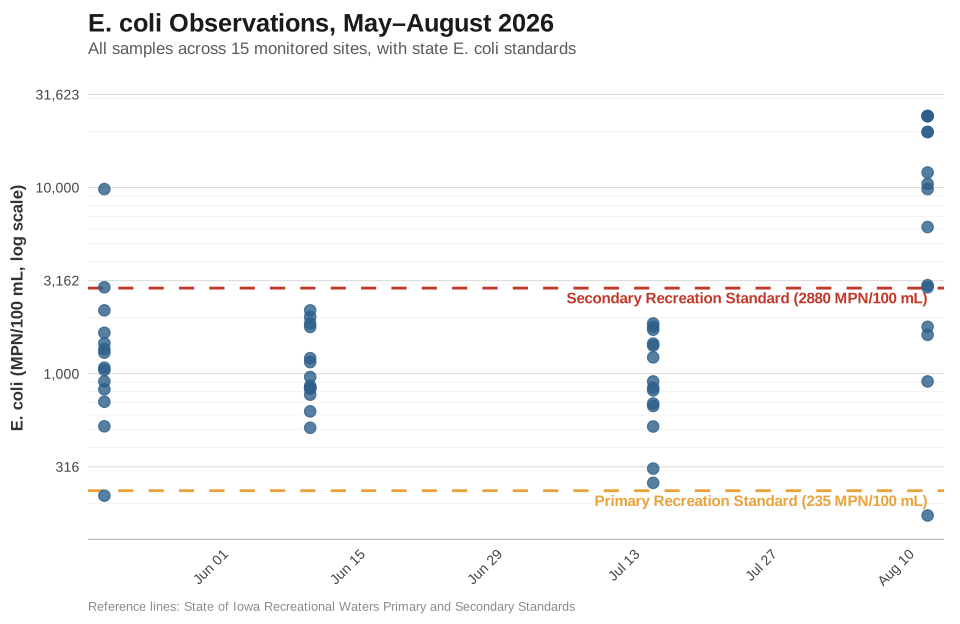
E. coli data from 15 sites regularly monitored by Prairie Rivers in Story County. The dashed lines represent the Iowa DNR’s recreational safety standards based on designated use categories.
What does this mean for human health?
E. coli is generally viewed as a proxy measure of fecal contamination and risk of illness. So high E. coli, everywhere, all summer, suggests a near ubiquitous distribution of fecal material and associated pathogens in our rivers and streams. Sounds disgusting, right?
According to the DNR, however, the risk to human health is limited. “The designated recreational uses of many Iowa waters—especially rivers and streams—are impaired by high levels of indicator bacteria, but reports of waterborne illness related to these high levels of bacteria have been extremely rare in Iowa over the last 40 years.” To be fair, not all E. coli strains that show up in tests are pathogenic, and actual human exposure in many of these waters is limited. Further, it turns out that some strains of E. coli can persist outside of the gut, so E. coli doesn’t always signal fecal contamination (source). Still, the risk of illness does rise and fall with E. coli levels, and the EPA standards set to prevent illness are being violated time and time again.
What can we do?
In order to design solutions, we first need the answer to a critical question: where is the E. coli coming from?
Is this a human waste problem like non-permitted discharge or aging municipal sewers? Is it agricultural: cows in streams, manure runoff from fields, or illegal discharge from CAFOs? Or could it be the unavoidable consequence of urban and suburban ecology? Concentrated populations of humans, dogs, and wildlife (looking at you, deer and raccoons) produce a lot of waste that might be driving the problem.
Each source requires a different solution, and we can’t mitigate contamination if we can’t identify the source. So who is responsible?
This is the question Prairie Rivers set out to answer.
DNA Forensics: Microbial source tracking with qPCR
Recent advances in genetic technology have made it possible to track the source of E. coli by identifying DNA fragments floating in our streams and rivers. All you need to do is to collect a water sample from a stream of interest, filter it through a specialized filter designed to capture DNA, and send it to a lab with the proper tools and tech.
The technology in question, called quantitative PCR, or qPCR, is able to count DNA fragments and identify the species they came from. This tells us which species are present in a stream and how much DNA they are shedding. By linking this data with E. coli counts, we can infer the most likely source or sources at each stream segment.
We sampled 23 sites on July 15, 2026. Most sites are part of our monthly monitoring routes, but additional sites were added based on public interest and suspicion of contamination. We included a sample of effluent from the Ames Waste Water Treatment facility to control for contributions of sterilized DNA. Samples for qPCR were screened based on initial E. coli levels. Samples with highest E. coli were selected for DNA source tracking. Because this was a single sampling event, the results are a snapshot, and sources can shift with season and weather.
One important caveat about qPCR: it does not identify every single species present in a sample. Rather, we have to select target species that we think are likely contributing DNA beforehand. This means that non-target species could be contributing fecal material, but we won’t be able to tell. For example, we did not include fish in our targets species list, and so we found no fish DNA, despite the fact that fish DNA is certainly in the water. We were only able to test for standard targets species, including humans, livestock species, and dogs. For a subset of samples(6/15), we were able to test for wildlife- raccoon, deer, Canada geese- in addition to the standard species.
Results
Interactive Map
This map shows where in Story County we sampled, the population of E. coli at each site, the categorical breakdown of the DNA sources, and the species level DNA counts.
Humans and Cows Everywhere

Color-coded barchart showing source species presence vs total number of sites, and categorical description of source strength based on number of DNA copies present.
Humans, present at 15/15 sites, and cows (13/15) were the most widespread source species across the county. Humans and cows were also the only two species contributing enough DNA at a single site to be considered “spill/major leak” level sources. Chicken DNA was relatively common, though mostly in trace amounts. Both sheep and swine were rare, with each rising into the “clear source” category only once. Dog DNA was found widely in our samples but did not represent major sources of fecal material. Raccoon and deer were significant contributors in every sample tested for wildlife DNA, while Canada geese only showed up in one site.
A Closer Look

The boxes represent the middle 50% of that species’ results (from the 25th to the 75th percentile). The line inside the box marks the median. The whiskers (the thin lines extending from each end of the box) show the typical range of the data beyond the middle 50%. The dots are every individual sample result.
This chart shows a closer look at the distribution of DNA copies by species across all sampling sites. As noted before, humans and cows contributed much more DNA, on average, than any other species. Raccoons and deer were close, despite only being tested for in a subset of samples. Dogs, sheep, and pigs barely registered in most samples. Chickens did make an appearance, but certainly not enough to move the needle on E. coli.
Something Might Be Missing.

This chart shows the total number of DNA copies, the species categories they came from, and the corresponding E. coli data from that site.
Here we see how much DNA is in the water and how well that connects to E. coli levels. In our data set, the relationship is inconsistent. There is a good correlation in the first few sites, with E. coli values following total DNA. This suggests that DNA can be connected to E. coli to infer the source.
However, in several instances, E. coli was very high, while DNA copy counts were relatively low(e.g. College Creek, Clear Creek, S. Skunk at Story City, and Bear Creek). This could suggest the presence of a significant source species that we did not test for, or could point toward difficulties in drawing direct connections between environmental DNA and E. coli populations. It’s possible that E. coli populations exist in our rivers and streams independent of fecal contamination. We’ve seen evidence of this on our beaches, so why not in our streams?

Whose Poo? Whose Problem? Everyone’s.
Humans
It should probably not come as a surprise that human DNA occurred in every single sample. We are rather abundant and, despite our best efforts, never perfect in keeping our waste out of our water – especially in urban areas where humans are concentrated. Samples of the treated Ames waste water effluent showed human DNA, so it’s not like human DNA is necessarily a red flag. We did, however, find some red flags.
Specifically, what’s going on in Ballard Creek at Cambridge? E. coli colony counts there are always among the highest in our long term monitoring data set, and here we found more human DNA than DNA from all other animals combined at any other single site in the data set. With that much DNA, plus consistently high E. coli, the issue bears more attention. Could sewer water be escaping into Ballard Creek through aging city infrastructure? Could unregulated septic discharge in the watershed be responsible? For now, it’s hard to say for sure, but we will be following up with repeated sampling to hone in on the source.
Livestock
Many of our more rural sites were dominated by DNA input from cattle, most conspicuously at Keigley Branch. With multiple eyewitness reports of cattle wading there, it’s no surprise that both E. coli colony counts and cattle DNA were as high as they were. Manure deposited directly in a stream is a potent E. coli source, and the bacteria can persist and even multiply in manure and streambed sediment.The source was so potent it seems possible that it’s responsible for E. coli populations as far south on the S. Skunk as North Riverside Park, in Ames. Cows are known to carry pathogenic strains of E. coli, so this is a major concern.
Notably absent from the livestock data was pig DNA. With the exception of a few DNA copies in the Ames waste water treatment effluent (probably from our diets!), we saw almost zero trace of swine in any of our samples. This could simply reflect the timing difference between our sampling event and manure application. Most manure is spring or fall applied, and as we noted earlier, field manure is a much less potent source of E. coli than direct deposit, especially months after application. On the other hand, perhaps we are seeing the results of responsible manure use. When applied at the right rate, time and place, with run-off mitigating practices like cover crops and no-till, manure can be all upside.
Wildlife
Would you believe it? Wildlife, namely raccoons and deer, are the number one contributors of DNA in at least three streams in Story County. The South Skunk at Story City, along with College Creek and Clear Creek in Ames, are rife with wild droppings.
As many Iowans are well aware, deer and raccoon populations are very robust today, largely driven by removal of predators and favorable habitat creation in urban and suburban environments (did someone say trash panda?). They live in greater numbers in small fragments of habitat, so they, along with their fecal matter, end up extra concentrated in built environments. A stream in a large, undisturbed forest probably wouldn’t show E. coli this high from wildlife alone. What we’re seeing is wildlife packed into fragmented urban habitat.
Conclusions
E. coli is undeniably widespread and highly abundant in much of Iowa, though risk to human health isn’t exorbitantly high. The sources vary widely between locations and over time, so it’s difficult to point fingers at any one source. If we want to meet state standards for recreation in all of our waters, we have to approach the issue on all fronts, a task much easier said than done. Even if we could address aging city infrastructure and failing private waste disposal systems, all while working to minimize agricultural inputs, we still won’t have dealt with wildlife, which as our data shows, is a major contributor.
We don’t like E. coli, and we like to raise hell when it comes from people and livestock, but what does it say about our standards for E. coli when deer and raccoons can push water quality outside of the acceptable range? What does it say that risk to human health remains low despite shocking statistics? Maybe it says that we need to approach these data with a nuanced understanding of E. coli, fecal contaminants, and risk. We need to balance the sensationalism around fecal contamination and sickness with actual risk and exposure, all while finding reasonable compromises to improving water quality across the board.
Further Reading
You can find more info on E. coli and surrounding regulations at these sites:
https://programs.iowadnr.gov/adbnet/Assessments/Summary/2026
https://programs.iowadnr.gov/adbnet/Docs/Codex/Designated%20Uses
https://programs.iowadnr.gov/adbnet/Docs/Codex/Impaired%20Waters
Acknowledgements
This work was made possible by contributions from the Izaak Walton League – Panora Chapter, the Outdoor Alliance of Story County, Story County Soil and Water Conservation District, and the Water Foundation.

Event: SOS Field Training 9/17/2026

Join US! Get Certified
Join Prairie Rivers of Iowa on:
Thursday, September 17, at 1:00-3:00pm
at Emma Lee McCarthy Park, Ames,
3400 Ross Road, Ames, 50014
as we get certified for biological stream monitoring through the Izaak Walton League of America “Save Our Streams” program.
This free national citizen science program trains volunteers to identify common aquatic organisms and assess stream habitat. This approach generates robust historical data and supports real conservation efforts. Read more about the program at iwla.org/save-our-streams.
Ginny Malcomson, Polk County Water Quality Coordinator and IWLA Certified Trainer, will be leading the training. All ages are welcome. Registration is required because event space is limited. Additional trainings will be arranged if demand allows.
NOTE: To get officially certified by IWLA, you must complete an online portion in addition to the field training here provided. The online portion does not need to be completed before the event, however it can be helpful in preparing for field identification of macroinvertebrates. All information can be found at iwla.org/save-our-streams-online-certification
Meet Up


Contact Casey Greufe at cgreufe@prrcd.org for more information.
We look forward to seeing you there!

Mussel Relocation at Hannum’s Mill Dam
Buttons and Pollution: Mussels in Peril
Fresh water mussels are among the most threatened group of animals on earth. In North America, over 70% of the continent’s roughly 300 species are threatened, endangered, or extinct. Iowa alone has lost twelve of its fifty four native species, with nine more endangered and six threatened. Why?
The problem began in the late 1800s. Mussel shells became prized for making pearl buttons, driving the creation of a massive industry in Iowa. Muscatine (aka Pearl City) was the biggest producer of pearl buttons in the world, capable of churning out 1.5 billion buttons a year. By 1900, the demand for shells destroyed local mussel populations. Soon after, plastics would displace pearl buttons, and the industry, along with its demand for shells, dried up.
Despite the ultimate failure of the pearl button industry, mussel populations are still imperiled across the state. As relatively immobile filter feeders, they are completely dependent on good quality water to survive. Erosion, nutrient pollution, and low oxygen all negatively affect mussels. So when water quality is poor, as it is in most Iowa streams and rivers, mussels suffer.


Locally threatened species Creek Heelsplitter (left/top) and Cylindrical Papershell (right/bottom)
The Mission: Save Some Mussels

Hannum’s Mill Dam
Hannum’s Mill Dam
In preparation for an upcoming modification of Hannum’s Mill Dam on the South Skunk River just north of Ames, IA, Story County Conservation staff, DNR biologist Jennifer Kurth, and volunteers set out to find and relocate mussels downstream of the dam. While dam removals and modifications can ultimately benefit mussel populations, short term changes in water levels and disturbances to sediments can leave mussels exposed to the air or fatally buried in silt. By relocating them before construction begins, we can ensure minimum harm and greater future population success.
The crew set out on foot, searching for mussels visually and by scouring the gravel and sand by hand. Mussels typically bury themselves vertically in the substrate with their “mouths” – more accurately called intake siphons – poking up into the water to collect food from the water. In the video below, you can see Story County Conservation Tech Kallie Webber unearth a Plain Pocketbook mussel with its foot extended, a fleshly, muscular organ used to dig and hold on to the substrate.

By the end of the afternoon, the team managed to collect more than 450 mussels, including two locally threatened species, the Creek Heelsplitter and Cylindrical Papershell. Finding these species highlights the importance of this work. By relocating them prior to dam modification, we can give them a chance to contribute to the continuation of their species.

Volunteer and Prairie Rivers board member Rick Dietz helps sort mussels by species.
If you’re interested in this kind of work, consider volunteering for this year’s Mussel Blitz on August 17-19. Reach out Jennifer Kurth with the DNR Watershed Improvement Program: 515-639-8464 or Jennifer.Kurth@dnr.iowa.gov
A big thank you to Story County Conservation and the Iowa DNR for making this event possible.