by Janice Gammon | Aug 27, 2019
Can summer really be over? It seems every year it goes faster and faster. We, here at the Byway office, seemed to have packed quite a bit into our last 3 months. Five communities celebrated 150 years this summer- Carroll, Dow City, Grand Junction, Scranton, and Westside. 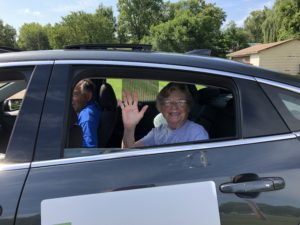 We entered a car into several of the parades and had Bob and Joyce Ausberger, Lincoln Highway Association members, help toss candy out to the crowd in Grand Junction. What a great way to share in the fun!
The Lincoln Highway Heritage Byway took 4 of the 11 days at the Iowa Byways booth under the grandstand at the Iowa State Fair (Aug 8-18) and talked to fair-goers about the unique Bywa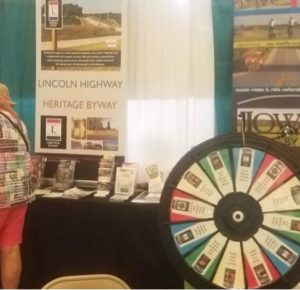 y routes in Iowa. We shared some history in a trivia spinning-wheel game. Everyone, of course, got a prize!
This year our new featured booklet at the fair was about the original 1919 Army Convoy, the Lincoln Highway, Henry Ostermann (the idea man behind the convoy and a man we have written about before), Dwight Eisenhower (who was on the original convoy)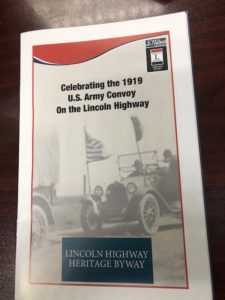 , and Dwight’s wife, Mamie, (who was born in Boone, Iowa). These booklets are available at some state Welcome Centers and select locations along the Byway route. And of course, you can always request copies from our office at jgammon@prrcd.org
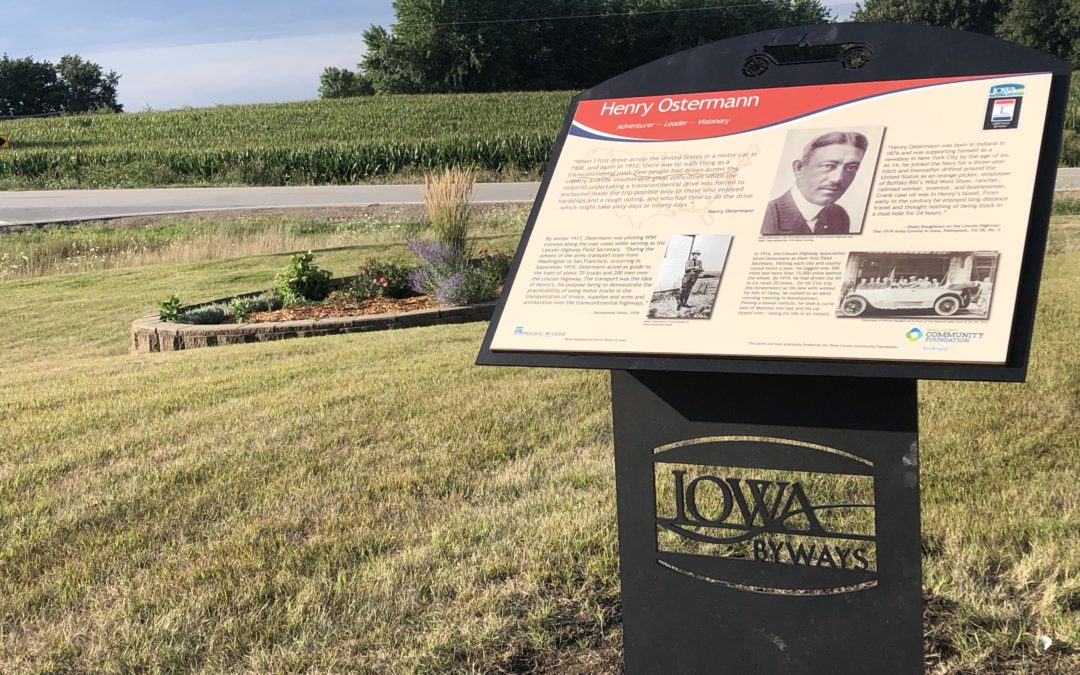
On August 15th, we unveiled an interpretive panel in the City of Montour’s Maple Hill Cemetery. This panel serves as a long overdue memorial to Henry Ostermann, who served the Lincoln Highway Association as their first Field Secretary and knew the road and the route better than anyone. He had been piloting convoys up and down the east coast in 1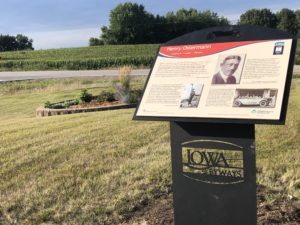 917 and came up with the idea to test men, equipment, and roads by taking a convoy across the nation- on the Lincoln Highway. His idea was a reality in 1919. In 1920, on his 21st trip across the nation (and his honeymoon), he lost his life in an accident east of Montour, near the cemetery. In the August-September 1920 Iowa Highway Commission Service Bulletin, the IHC called for a memorial to be placed near the accident site.
In 2019, it became a reality (99 years later). About 25 people gathered to witness this installation. A small program consisted of several speakers: Reed Riskedahl (Prairie Rivers of Iowa Board); Mary Preston (Iowa Lincoln Highway Association President); Dotti Thompson (Community Foundation of Northeast Iowa/Tama County Community Foundation); Rev. John Christianson (Living Faith Methodist Church of Montour), Sue Eberhart (Montour City Council); and Jan Gammon (Lincoln Highway Heritage Byway Coordinator). Gammon also reads words from Rep. Dean Fisher of Montour. Sue Eberhart and Vicky Garske, Montour City Council members, unveiled the panel for all to see. During the program, a few sprinkles fell from the sky. In retrospect, maybe it was Mr. Ostermann verifying his overdue acknowledgement.
A few days later, we celebrated Mr. Ostermann once again as the Military Vehicle Preservation Association (MVPA) retraced the route of the original 1919 Convoy. The original convoy traveled about 6 mph and this modern day group, with vintage vehicles, averaged 35 mph. There was a link to live tracking, so a person could fo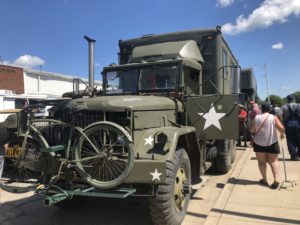 llow the convoy as it made its way across America. Our Byway staff caught up with the convoy in Belle Plaine, Iowa and then saw them again in Tama, Marshalltown, and Nevada. The convoy was impressed by the amount of people who came out to see them- whether on a city street or at the end of their rural lane. Byway staff had helped promote this event in Iowa- sending out press releases, sharing our booklet, and doing interviews with KROS Radio in Clinton and also with RadioIowa. We are most appreciative to the public for their response.
The Lincoln Highway Association will also bring a convoy of classic and contemporary cars, retracing the same route. They will be in Iowa September 6th and 7th, overnighting in Marshalltown and Council Bluffs. They will go a little faster!
Now with fall approaching, its time to regroup and look for funding for future projects. We have some already being planned, so stay tuned!
by Janice Gammon | May 23, 2019
One hundred years ago, in what began as the idea of one man, America was shown how motor trucks could transport troops, supplies, arms, and ammunition across the nation. This was known in 1919 as the First Trans-Continental Motor Transport Convoy.
The Idea and Development
Henry Ostermann, who we talked about in a previous writing, had been piloting convoys for the Army up and down the east coast in the winter of 1917, during World War I. He was also serving as Field Secretary for the Lincoln Highway Association and merged his two occupations into one idea for the convoy.
In “A Picture of Progress on the Lincoln Way”, published by The Lincoln Highway Association (LHA) in 1920, the LHA officers and the General Staff in Washington held a conference in June 1919 to discuss convoy details. The success of the run was due to the LHA supplying accurate data to the Army as a “result of its years of study of trans-continental highway conditions, and of the co-operation given to the Motor Transport Corps, not only by the Headquarters of the Lincoln Highway Association, but by the consular representatives all along the line between the two coasts. The spirit with which the undertaking was met by the general public and the highway officials at every point along the route, was also invaluable to the project.”

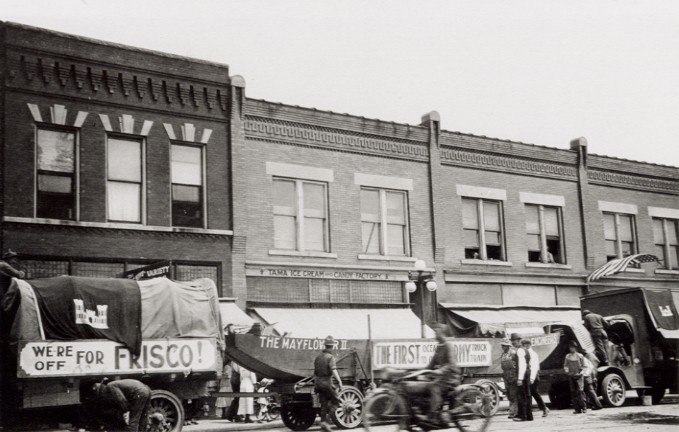
The 1919 Army Convoy taking a break in Tama, Iowa. LHA Archive, Transportation History Collection, Special Collections, University of Michigan
The Route and Key Personnel
On July 7, 1919, send-off ceremonies were attended by high ranking United States officials, including Secretary of War Baker; General Marsh, Chief of Staff; and many leading U.S. Senators and Representative. At the conclusion of the celebration, the convoy left from “Zero Milestone” near the south lawn of the White House in Washington, D.C.. A marker stands there yet today to commemorate this historic adventure undertaken by the Army. The convoy left from Washington and caught the Lincoln Highway at Gettysburg, Pennsylvania. (The Lincoln Highway actually begins in Times Square in New York.)
From the LHA, “The convoy, consisting of 72 vehicles, 65 of which were motor trucks of all types used by the Government during the war, with a personnel of 260 men and 35 officers as statisticians and observers for the various branches of service, under the command of Lt. Col. Charles B. McClure and Capt. Bernard McMahan, and led by Field Secretary and Vice-President H.C. Ostermann of the LHA, in the Association’s Packard, traversed the continent, covering a distance of 3310 miles from Washington to San Francisco, in sixty-two days, arriving only four days behind the schedule laid out in Washington before the start.”
A young Lt.Col. Dwight Eisenhower was one of the men on this trip. He caught up with the convoy at the first overnight location in Frederick. Maryland. He wrote about his experience and his report is on file at his Presidential Library and Museum in Abilene, Kansas. https://www.eisenhower.archives.gov.

Washing dust from a 1919 Army Convoy vehicle in Cedar Rapids. LHA Archives, Transportation History Collection, Special Collections Library, University of Michigan
What the Convoy Taught Us
Eisenhower found most of the drivers in need of additional training and, as with the rest of the convoy leaders, felt the nation’s roads to be lacking. In the Eastern United States, they were often paved but sometimes too narrow for the large equipment. West of Chicago, roads became graveled. Iowa was lucky because it had not rained which would have turned the unpaved road to “gumbo.” The “Seedling Mile,” a one mile of paved road in Linn County near Cedar Rapids, Marion, and Mount Vernon, was completed just prior to the Convoy. The group did not write about it much. As it was, the ground in Iowa was very dry and the convoy, according to the State Center Enterprise, stretched out for as much as 10 miles. Vehicles were kicking up quite a bit of dust and hindering the men and trucks following them. Nearly one hundred bridges were broken and repaired across the nation, though we have no record of any in Iowa. (Iowa was a leader in bridge building.)
This experience showed that America needed to improve roads and the federal government needed to step in with funding instead of leaving it to the locals and counties to build their own roads. How county secondary road departments, county engineers, Federal Highway Commission, and the Department of Transportation developed is a story all its own- which we will address in a later writing.

1919 Motor Convoy crossing the Lincoln Highway Bridge in Tama, Iowa. LHA Archives, Transportation History Collection, Special Collections Library, University of Michigan

What could have happened in Iowa if it had rained! LHA Archives, Transportation History Collection, Special Collections Library, University of Michigan
Celebrating the Convoy 100 Years Later
This one idea from one man helped change the course of transportation. This year, in 2019, we will celebrate the convoy as the Military Vehicle Preservation Association (MVPA) travels the same route, from Washington, D.C. to San Francisco, and will overnight in Iowa- DeWitt (Aug 22), Marshalltown (Aug 23), and Denison (Aug 24). The MVPA call their convoy the “longest Veteran’s parade in the nation.”
The Lincoln Highway Association will also celebrate with their own D.C.-to-San Francisco convoy and overnight in Marshalltown (Sept 6) and Council Bluffs (Sept 7). Be sure to line the route and wave either flags or hands (or both) to the convoys as they come through your neck of the woods.
by Janice Gammon | Jan 29, 2016
The Corridor Management Plan is coming along nicely. From our community input meetings, reviewing city comprehensive plans, and discussions with officials in communities and counties along the Byway we certainly have an exhaustive amount of information and ideas to make a very detailed living document.
I have kept my nose to the grindstone for a while now and did come up for air last week when I took a few days off. The second day back, I attended the Travel Federation of Iowa’s Legislative Showcase at the State Fairgrounds. This was the first event I attended last year when I began as the coordinator of the Lincoln Highway Heritage Byway. I know SO much more about the Lincoln Highway and Byways in general than I did last year at this time. I was able to talk about the Lincoln Highway and the Iowa Byway program to the legislators as they passed by the Iowa Byways’ booth and encouraged them to continue their support of tourism.
This event is also a great way to network with chambers and attractions along the Byway. I chatted with Alan from the Boone and Scenic Valley Railroad, Mark from Council Bluffs Convention and Visitors Center, Taylor from the Cedar Rapids Area Convention and Visitors Bureau and many others. I also had a chance to talk with my fellow Byway coordinators about projects, successes, and challenges.
An upcoming event will be hosted by the Iowa Byways. The Heartland Byway Conference will be April 4th-6th in Council Bluffs and we are very excited to have attendees learn more about Western Iowa including the Loess Hills Scenic Byway, Western Skies Scenic Byway, and the Lincoln Highway Heritage Scenic Byway. These three Byways intersect and conjoin for a bit at the Harrison County Historical Village and Welcome Center in Missouri Valley, just north of Council Bluffs. One afternoon, we will take a tour of the Loess Hills and this will be one of the stops.
Key note speakers at the conference will be Michelle Matt, Chuck Offenburger, and the Path Less Peddled. Breakout sessions will include topics such as working with volunteers, GIS, interpretive plans, marketing, infrastructure, corridor management planning, team work, and creating an authentic experience. Anyone interested in Byways and tourism or involved with chambers, visitor bureaus, or serves on an advisory board or volunteers at an attraction is welcome to attend.
I am so excited to be a part of this event! Besides increasing my knowledge and networking with fellow professionals, there will be great food and that bus trip through the Loess Hills! I am looking forward to spending time on this side of the Lincoln Highway Heritage Byway and experience the Loess Hills, Hitchcock Nature Center, and the communities along the route. I am also excited to reconnect with the other Lincoln Highway Byway coordinators from Indiana, Ohio, and Nebraska. We met at the National Scenic Byway training last summer in Ohio and made plans to meet again in Council Bluffs!
If you want to attend, please register at www.brownpapertickets.com. The conference will be held at the Holiday Inn & Suites, 2202 River Road in Council Bluffs. I will tell you all about it in future posts. Be sure to check our Facebook page for photos!
by Janice Gammon | Nov 19, 2015
In my first year as the coordinator, I have enjoyed traveling on the Lincoln Highway Heritage Byway and seeing the seasons change. I remember how wonderful it was to see the green grass emerge and the trees starting to bud. Then later in summer, due to timely rains, the grass remained green and the crops were maturing. This fall, everything seemed to be a golden color as crops were harvested and tree leaves began change color and drop.
Today the sun is out, but the wind is howling and tomorrow’s forecast is for SNOW! We all knew it would happen sometime and I guess we should be happy we have avoided it so far. I know as an Iowan, snow is inevitable. This forecast has me thinking.

© Carl Kurtz
Yesterday, I was asked to submit winter photos along the Byway for a marketing program. As I looked at the photos we have on file, I began to make peace with the approaching season. Winter can be truly beautiful. There was the photo of a cottonwood stand against a winter blue sky and the crisp new white snow. Reminded me of my childhood home and the cottonwoods in our yard and along the creek.

© Mike Whye
In another picture, an older barn and the newly fallen snow looked so quiet and peaceful. I could almost hear the crunch of the snow under my feet, if I were to walk towards the barn. Compare that to the photo of people skiing at Seven Oaks near Boone. There were people in the ski lifts and parents, children, and teenagers enjoying the day. Lots of voices, laughing, and shouts to each other would fill the air. I can imagine they will be sad when that season ends and the snow melts away.
Even the photo of a random snowbank makes you stop and think how does Mother Nature make such interesting sculptures with just moisture, cold, and wind? Compare that to the photo of the snowplow blowing through large drifts on the roadway. We rely on these public servants to keep us safe while we travel whether for business or pleasure.
And the photo of the Reed-Niland Corner, still open for business. Carrying on. Won’t let a little snow stop them from serving great food and sharing the story of the Lincoln Highway with visitors.

© City of Colo
Snow is coming. It will happen. How will I enjoy it? You know, years ago I tried cross-country skiing in Canada. I really enjoyed it. I always thought I’ d like to try it here in Iowa. Hmm. This might be the year. I know of many county and city parks around me where skiing might be possible. I just might head to the outdoor store and get setup to do that!
Let me know how you are going to enjoy this season along the Lincoln Highway Heritage Byway. Whether it might be ice fishing, snowmobiling, snowshoeing, or even joining me in some cross country skiing, share your experiences on our Facebook page. This Byway can be enjoyed anytime of year! It has so much to offer.
by Janice Gammon | Aug 17, 2015
Summer has been a busy time along the Byway! I did make it to the Mahanay Bell Tower Festival in Jefferson and rode the elevator 120 feet up to the observation deck of the 14-story Tower. What a view!! It gave me a whole new perspective of the countryside and it was great to see the Lincoln Highway as a ribbon running through it. I also enjoyed the beautiful Thomas Jefferson Gardens and RVP~1875, where they make furniture with only hand tools. Its like stepping back in time and they’ll even show you what they are working on!
Another great tour is the Sawmill Museum in Clinton in the Lyons District on the north side of the city. Lyons was the name of the town where the first bridge linked Illinois to Iowa on the Lincoln Highway. Lyons is now part of Clinton. The Sawmill Museum has great displays of the history of the lumber industry in Clinton. It was a “must see” for me and I recommend it for all ages.
The annual Lincoln Highway Association conference was held in Ann Arbor, MI this year. Participants could tour downtown Detroit, the Packard proving grounds, and the archives at the Bentley and Hatcher Libraries at the University of Michigan. Detroit is not on the Lincoln Highway, but has deep connections to the auto industry and to the men who organized the Lincoln Highway and its route.
Another event, although held in Ankeny, did bring a focus to the the Lincoln Highway Heritage Byway when the Harley Owners Group (H.O.G.) Rally had, among many rides, a featured ride to Marshalltown and then to Ames via the Byway. Prairie Rivers of Iowa set up a booth at the H.O.G. Rally and gave out information about the Lincoln Highway Heritage Byway and the Byway program in Iowa. Motorcyclists are very interested in the 2-lane scenic views as their ride (journey) itself is often more important than the destination.
The most recent event I attended was the 101st Meskwaki PowWow held just outside of Tama. I enjoyed the music and dancing, native items for sale, and food vendors. I especially liked the Indian fry bread. Next time I’ll try it as an Indian Taco. Although they invited the spectators to come join in the last dance, I did not. I’ll do that next time as well! Pacing myself.
I am able to travel the state along the Byway and learn more about the communities and their history, strengths, challenges, and plans for the future. We continued the Corridor Management Plan community input meetings,having now held 15 of them across the state. By meeting many of the community leaders and members in each town, we have been able to gather insight into what the Lincoln Highway has done for their community and what it can do for them in the future.
Many communities and counties are working on future ideas as well such as the Story County Cornerstone to Capstone (C2C) project and the plans for the Nevada downtown streetscape. The Boone Historical Museums are partnering with the University of Iowa in developing their 4 museums. I have been working with residents and government officials concerning bridges in the city of Tama and in Linn County. A new Grant Wood mural has been painted on the side of a building in eastern Iowa. The overpass outside of Grand Junction will be replaced in the next few years. There are so many more projects and Ideas in different phases along the Lincoln Highway. It will be exciting to see them all come to fruition!
We are working on a baseline measurement of the economic impact of the Byway. If you are traveling the Lincoln Highway, please stop in one of these locations and fill out a survey about your trip: Sawmill Museum in Clinton, the Belle Plain Museum in Belle Plaine, Lincoln Cafe and Wine Bar in Mt Vernon, John Ernest Vineyard and Winery outside Tama, King Tower restaurant in Tama, Niland Cafe in Colo, Greene County Museum in Grand Junction, Mahanay Bell Tower in Jefferson, Cronk’s restaurant in Denison, the Harrison County Historical Village and Iowa Welcome Center in Missouri Valley, and the Union Pacific Railroad Museum in Council Bluffs.
There will also be a survey for residents to fill out and we should be rolling that out this fall, so stay tuned.
In the meantime, let’s get traveling the Lincoln Highway Heritage Byway!

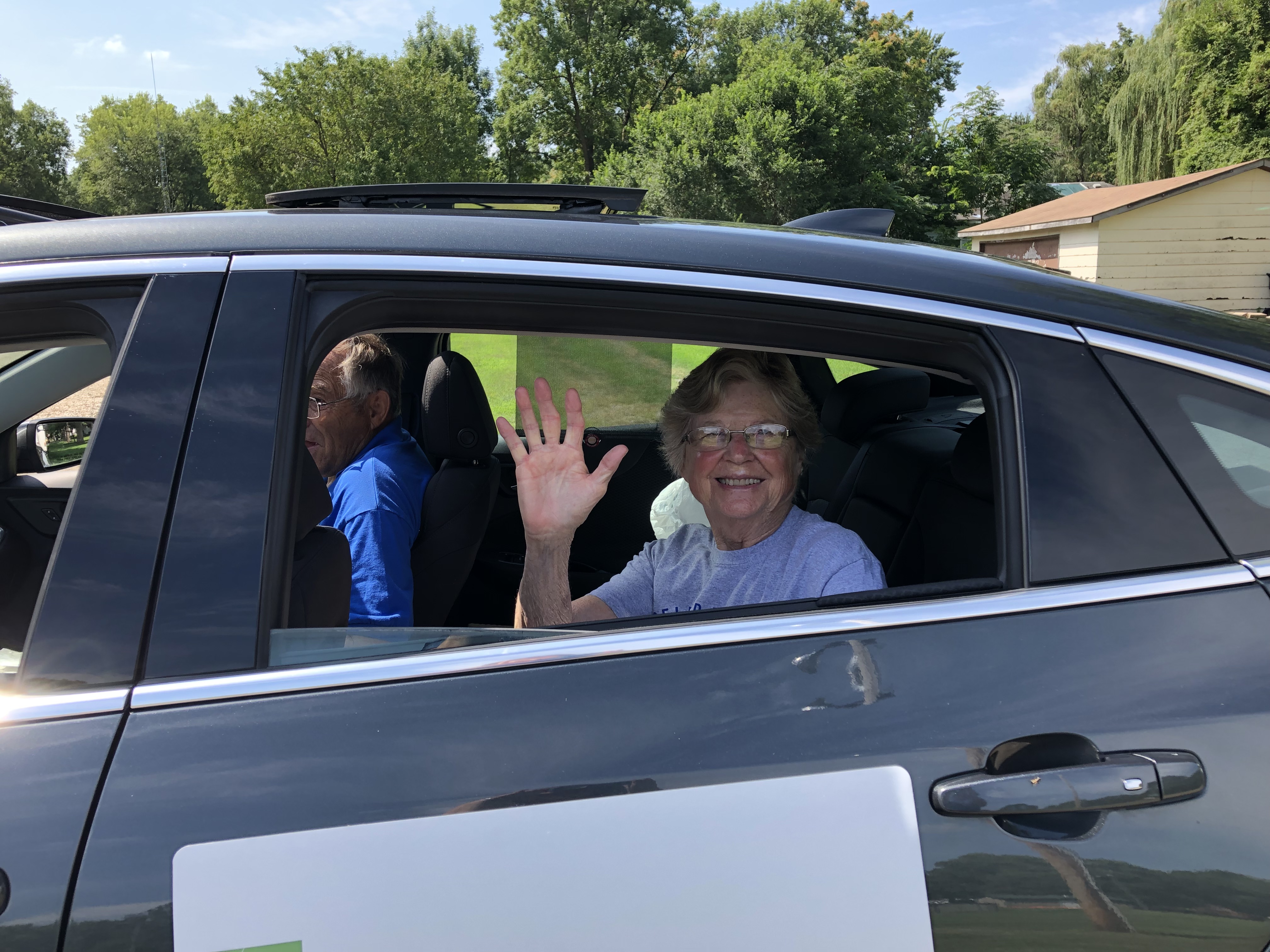 We entered a car into several of the parades and had Bob and Joyce Ausberger, Lincoln Highway Association members, help toss candy out to the crowd in Grand Junction. What a great way to share in the fun!
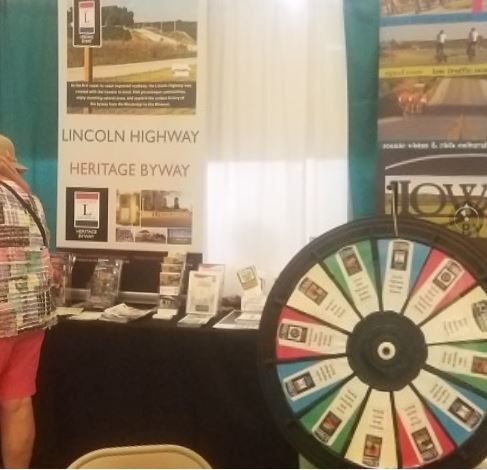 y routes in Iowa. We shared some history in a trivia spinning-wheel game. Everyone, of course, got a prize!
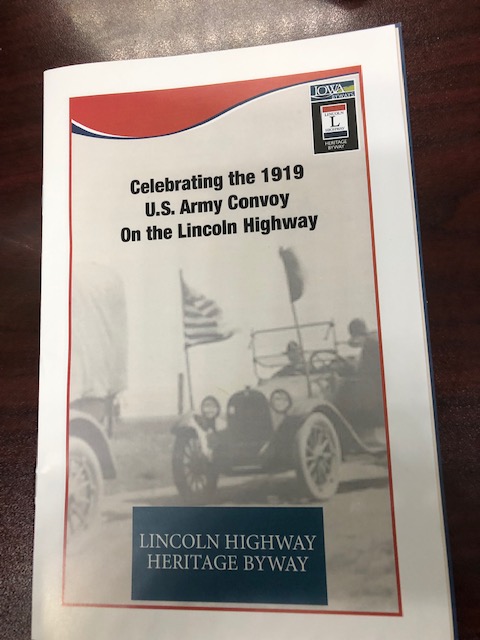 , and Dwight’s wife, Mamie, (who was born in Boone, Iowa). These booklets are available at some state Welcome Centers and select locations along the Byway route. And of course, you can always request copies from our office at jgammon@prrcd.org
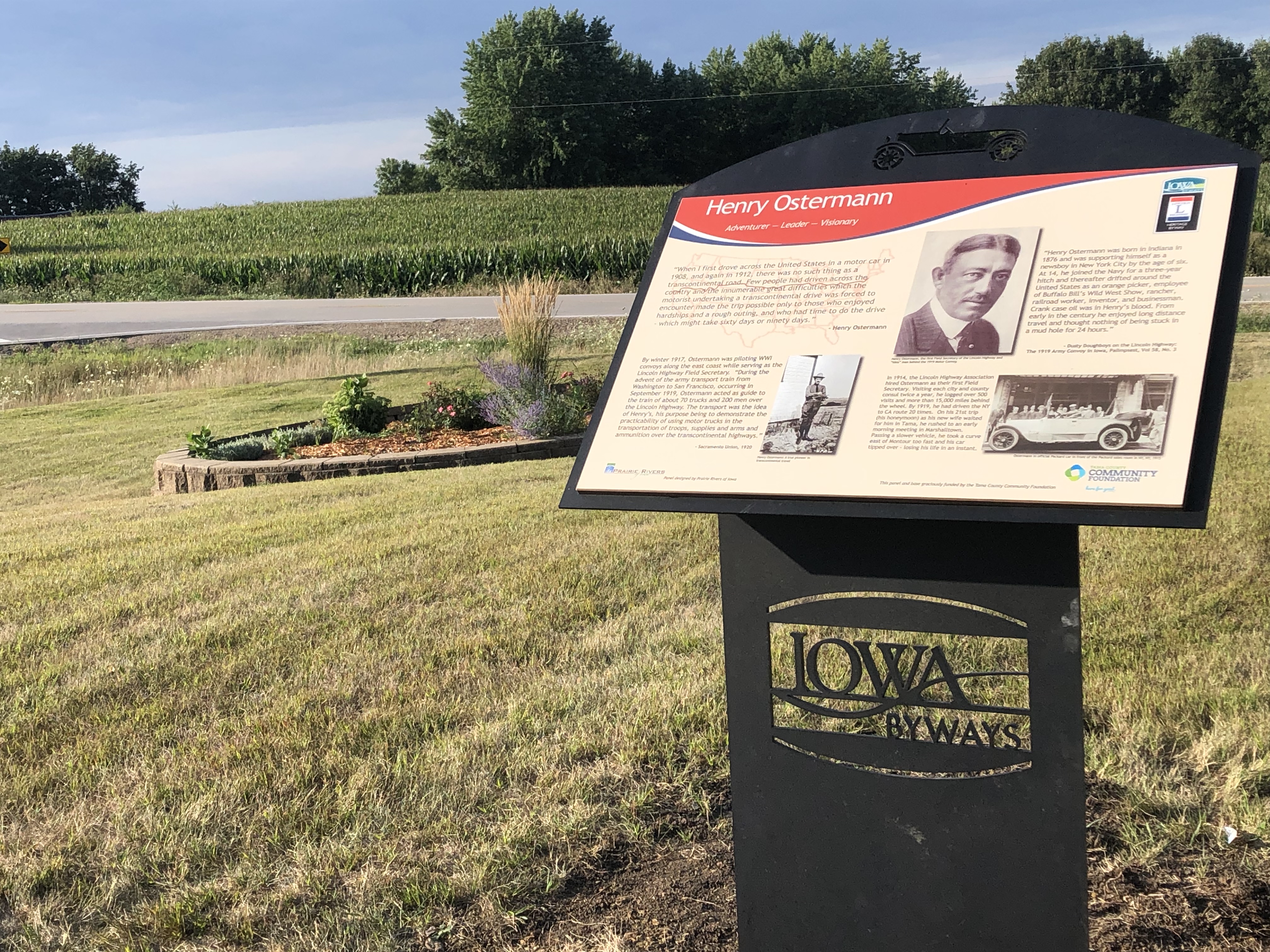 917 and came up with the idea to test men, equipment, and roads by taking a convoy across the nation- on the Lincoln Highway. His idea was a reality in 1919. In 1920, on his 21st trip across the nation (and his honeymoon), he lost his life in an accident east of Montour, near the cemetery. In the August-September 1920 Iowa Highway Commission Service Bulletin, the IHC called for a memorial to be placed near the accident site.
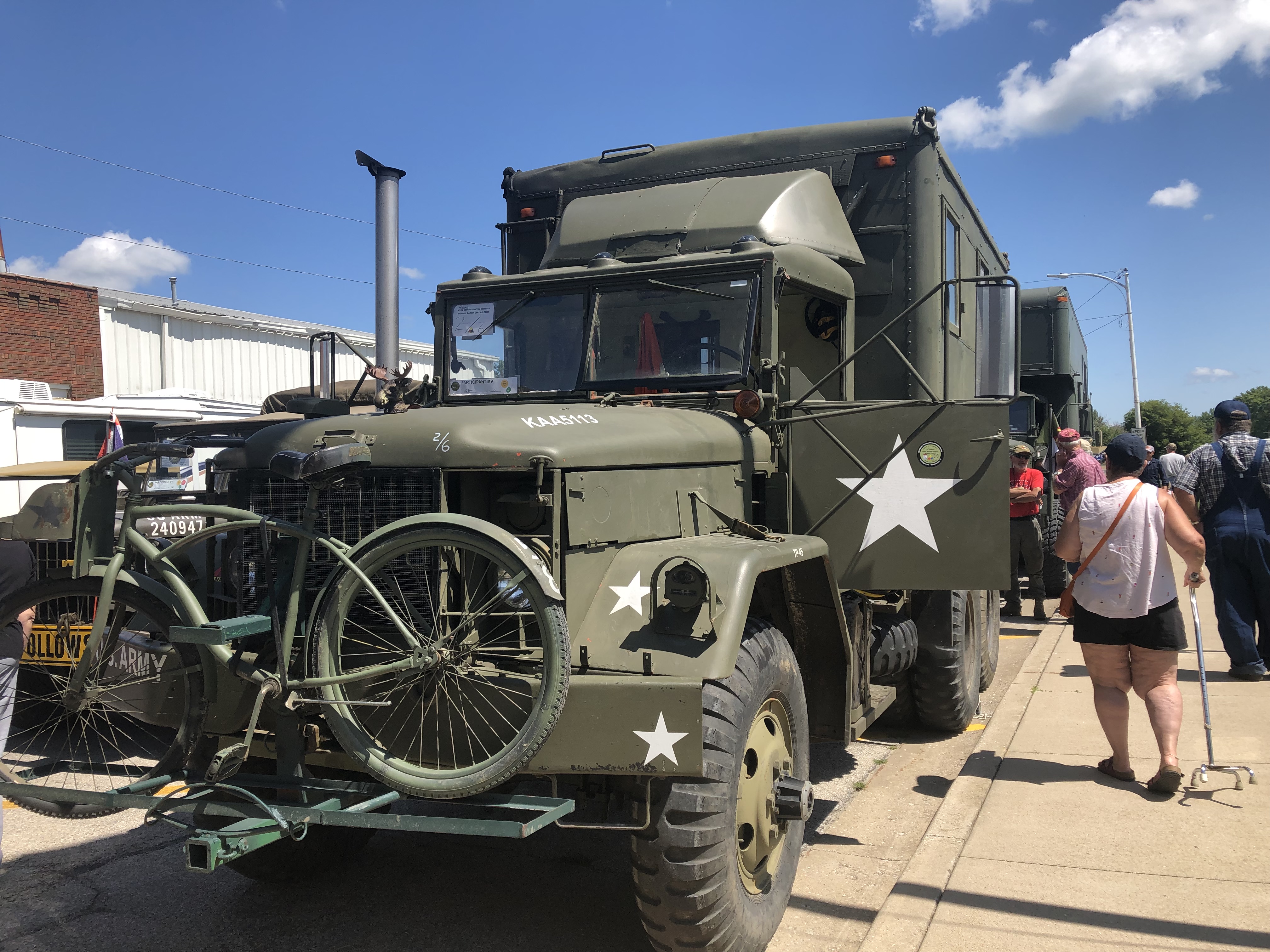 llow the convoy as it made its way across America. Our Byway staff caught up with the convoy in Belle Plaine, Iowa and then saw them again in Tama, Marshalltown, and Nevada. The convoy was impressed by the amount of people who came out to see them- whether on a city street or at the end of their rural lane. Byway staff had helped promote this event in Iowa- sending out press releases, sharing our booklet, and doing interviews with KROS Radio in Clinton and also with RadioIowa. We are most appreciative to the public for their response.


